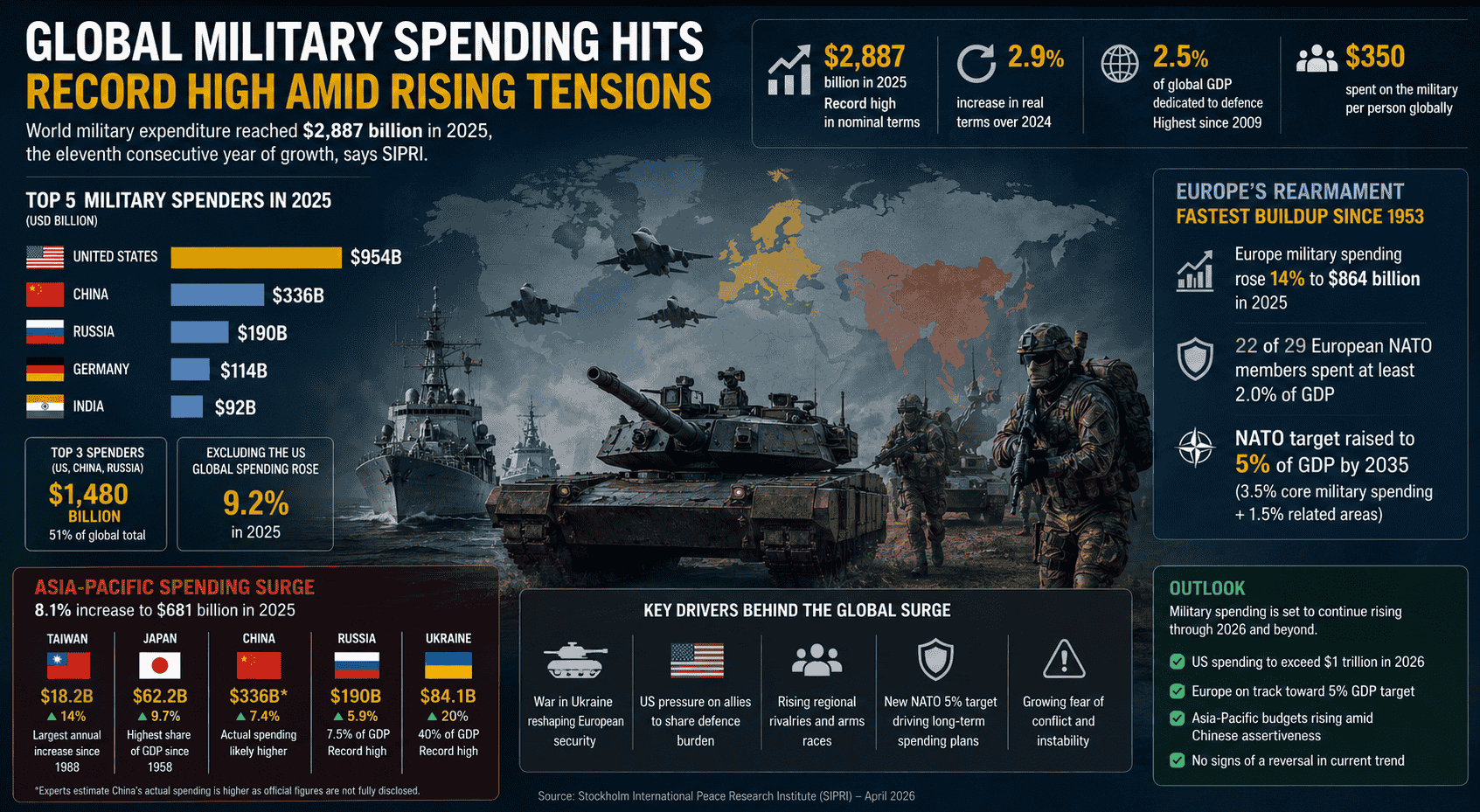
World military expenditure reached $2,887 billion in 2025, an increase of 2.9 percent in real terms over 2024, marking the eleventh consecutive year of growth, according to new data published by the Stockholm International Peace Research Institute (SIPRI). The number is a record in nominal terms. But strip away the accounting effect of a temporary US pullback, and the underlying momentum is far more alarming.
Excluding the United States, global military spending surged by a substantial 9.2 percent in 2025, revealing the true momentum of worldwide militarisation. A world that appeared, after the Cold War, to be slowly demilitarising is now doing the opposite at pace.
Global military spending as a share of GDP climbed to 2.5 percent in 2025, its highest level since 2009. That figure matters because it captures not just how much countries are spending, but how much of their entire economic output they are now dedicating to defence. The direction is unmistakable.
What the headline numbers confirm:
- The five biggest military spenders in 2025 were the United States at $954 billion, China at $336 billion, Russia at $190 billion, Germany at $114 billion, and India at $92 billion, together accounting for 58 percent of world military spending.
- The top three spenders alone, the US, China, and Russia, spent a combined $1,480 billion, equal to 51 percent of the global total.
- Global military spending now amounts to roughly $350 per person on the planet.
- In 2025, military expenditure as a share of government spending reached the highest level ever recorded in both Russia and Ukraine.
Europe's Rearmament: The Fastest Buildup Since 1953
The defining story of 2025's military spending data is not Washington or Beijing. It is Europe.
The main contributor to the global increase in military spending was a 14 percent rise in Europe to $864 billion, representing the sharpest annual growth in spending in Central and Western Europe since the end of the Cold War. European NATO members have spent more than a decade being pressured by the United States to share the burden of collective defence. In 2025, that pressure combined with genuine fear of Russian expansion to produce a historic response.
Germany was the largest European NATO military spender, with its expenditure growing by 24 percent year-on-year to $114 billion. Germany's military burden exceeded the 2.0 percent NATO threshold for the first time since 1990, reaching 2.3 percent of GDP. For a country that has spent three decades navigating the politics of post-war restraint, this is a fundamental shift in strategic posture.
Spain's military spending increased by 50 percent to $40.2 billion, bringing its military burden above 2.0 percent of GDP for the first time since 1994. The 29 European NATO members spent a combined total of $559 billion in 2025, and 22 of them had military spending of at least 2.0 percent of GDP.
The political context sharpens the significance of these numbers. In June 2025, NATO member states agreed to raise the alliance's military spending target to 5.0 percent of GDP by 2035, a substantial increase from the previous target of 2.0 percent agreed in 2014. Of the 5.0 percent, a minimum of 3.5 percent must go to core military spending, while the remaining 1.5 percent can cover what NATO terms defence- and security-related spending.
European military spending drivers:
- Five years of war in Ukraine erasing assumptions about European territorial security
- US pressure on allies to reduce dependence on American military guarantees
- The new NATO 5 percent of GDP target agreed at the June 2025 summit
- Domestic political shifts in Germany, Spain, and Poland toward higher defence budgets
- Warnings that Russia could attack a NATO country within three years driving urgency across the alliance
Analysts at SIPRI have raised a concern that deserves serious attention. The vague definitions within the new NATO spending framework risk incentivising creative accounting, with Italy's reported attempt to count the cost of constructing a bridge to Sicily as military-related spending cited as an illustration of the problem. Higher spending targets are meaningful only if the numbers reflect genuine military capability.
Asia's Accelerating Arms Race and the Ukraine-Russia Equation
Europe is not the only region recalibrating its security posture. Asia is moving with equal urgency, driven by China's expanding military posture and deep uncertainty about the reliability of American security guarantees.
Spending in Asia and Oceania rose 8.1 percent to $681 billion in 2025, marking the largest annual rise for the region since 2009. The individual country figures reveal a region preparing seriously for strategic competition and potential conflict.
Taiwan's military spending rose 14 percent to $18.2 billion, its largest annual increase since at least 1988. The increase came amid intensifying military activity around the island by China's People's Liberation Army, with aircraft incursions around Taiwan rising sharply from 380 in 2020 to a record 5,709 in 2025.
Japan's spending jumped 9.7 percent to $62.2 billion, reaching 1.4 percent of GDP, the highest share since 1958. That figure carries historical weight in a country whose constitution has long constrained military ambition.
China, the world's second largest military spender, increased its spending by 7.4 percent to an estimated $336 billion. Experts have argued that China's actual number could be significantly higher, as Beijing does not fully disclose its military spending.
Meanwhile, the war in Ukraine continues to drain resources at an extraordinary rate. Russia's military spending grew by 5.9 percent to $190 billion, giving it a military burden of 7.5 percent of GDP. Ukraine increased its spending by 20 percent to $84.1 billion, equivalent to 40 percent of GDP.
Key Asia-Pacific military spending shifts in 2025:
- Taiwan recorded its largest annual defence increase since 1988 against a backdrop of record Chinese air incursions
- Japan reached its highest defence spending share of GDP since 1958
- Pakistan's military spending grew by 11 percent to $11.9 billion, driven largely by new aircraft and missile orders placed with China following the armed conflict with India in May 2025
- Australia and the Philippines also raised defence budgets amid growing uncertainty over US support in the region
The US trajectory adds a further dimension. US spending fell 7.5 percent in 2025 to $954 billion, primarily because no new supplemental appropriations for Ukraine-related Defence Department support were passed, compared to a cumulative $127 billion approved over the previous three years. However, spending approved by Congress for 2026 has already risen to over $1 trillion, and could rise further to $1.5 trillion in 2027 if President Trump's latest budget proposal is accepted.