A magnitude 7.8 earthquake struck off Sarangani in the southern Philippines on Monday morning, killing at least 19 people, injuring more than 100 others, and triggering tsunami waves along nearby coastlines. Seismologists confirmed it was the strongest earthquake to hit the Philippines since 1990.
The Philippine Institute of Volcanology and Seismology (PHIVOLCS) recorded the tectonic quake at 7:37 a.m. on Monday, initially logging it as a magnitude 7.0 before revising it upward to 7.8.
What Happened: Epicenter, Depth, and Immediate Impact
The earthquake's epicenter was located off the coast of Sarangani province, approximately 26 kilometers west-southwest of Kablalan, at a depth recorded between 33 and 55 kilometers depending on the monitoring agency.
Key facts at a glance:13
- Magnitude: 7.8, confirmed by the USGS.
- Time: 7:37 a.m. local time, Monday, June 8, 2026.
- Deaths: At least 19, mostly from collapsed buildings and landslides.
- Injuries: More than 200 people.
- Maximum recorded intensity: VII (Destructive) in General Santos City.
- Tsunami waves: Up to 1 meter detected along nearby coasts.
The initial quake was followed by more than an hour of aftershocks. General Santos, a city of 722,000 people in southern Mindanao, sustained the most serious structural damage.
Strongest Earthquake to occur till now:
- 1990 Luzon Earthquake - Magnitude 7.8.
- 2013 Bohol Earthquake - Magnitude 7.2.
- 2026 Sarangani Earthquake - Magnitude 7.8, the strongest earthquake recorded since 1990.
Damage and Response: Buildings Down, Schools Closed, Thousands Displaced
General Santos: Hardest Hit City
At least seven people were killed and around 130 others were injured in General Santos, where several small buildings partially collapsed and key structures including a main access bridge sustained dangerous cracks.
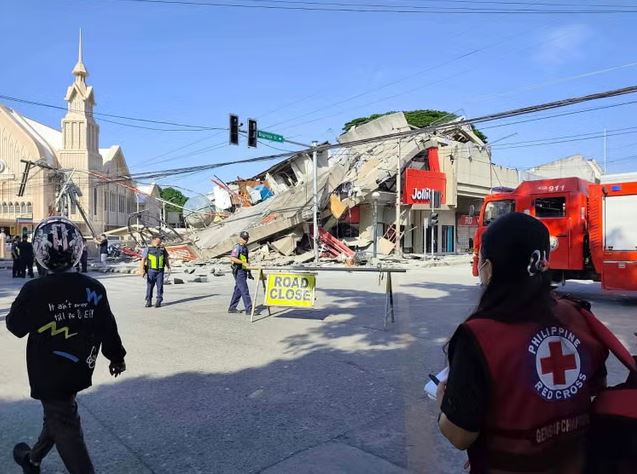
A three-story commercial building housing a Jollibee restaurant and a Love Radio station collapsed entirely. Parts of SM City General Santos and a building at Notre Dame of Dadiangas University also sustained major damage.
Parts of St. Elizabeth Hospital were severely damaged, forcing patients and medical personnel to evacuate and operate temporarily outside the main building.
Tsunami Warnings Issued Across the Region
Tsunami warnings were issued for the Philippines, Indonesia, Palau, Taiwan, and Papua New Guinea, urging coastal residents to move to higher ground immediately. Smaller waves were also measured as far away as southern Japan. The Pacific Tsunami Warning Center confirmed the threat largely passed about five hours after the quake.
Education and Civilian Disruption
Over 3.2 million students and 128,000 teachers across five Mindanao regions were affected by class suspensions. Approximately 6,224 schools were impacted, with the Department of Education activating emergency response protocols and conducting rapid structural safety assessments.
Government Response
Philippine President Ferdinand Marcos Jr. ordered the cancellation of classes and directed disaster-response agencies to begin immediate operations, stating the national government would not abandon Mindanao in the aftermath.