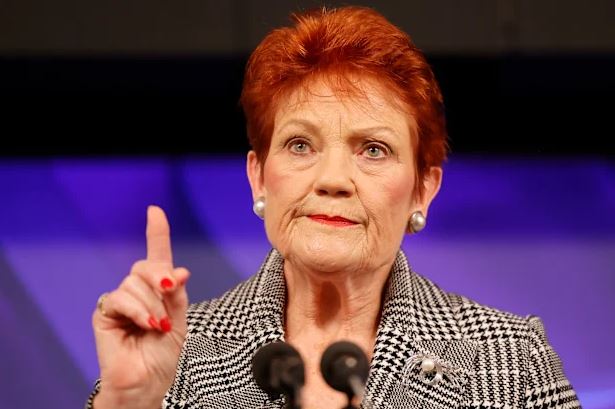
One Nation leader Pauline Hanson delivered her first National Press Club address on Wednesday, ranging across immigration, housing, energy, abortion, and public broadcasting in a speech briefly interrupted by a protest banner from activist group GetUp. Several of her specific claims are checkable against existing data and law, and the picture is more mixed than her framing suggested.
What Hanson Said About Immigration and Housing
Hanson described immigration policy as being in a "state of crisis" and called multiculturalism an "utterly flawed policy," arguing Australia can be multiracial but not multicultural. She cited a 2000 Australian Bureau of Statistics projection that the population would grow from 19 million to between 24 and 28 million by 2050, noting the country had already passed 28 million decades ahead of schedule. She also said net overseas migration totalled 1.27 million people over the first three years of the Albanese government, averaging more than 423,000 a year, and proposed capping annual migration at 130,000.
Checking the Numbers
The ABS population projection point is accurate, Australia did pass the 2050 upper estimate well ahead of time. The migration figures need more context, however:
- Net overseas migration peaked well above 400,000 a year during the post-pandemic rebound.
- The most recent financial year, 2024/25, recorded 306,000 net arrivals, down from 429,000 the year before.
- That means migration has already been slowing before any policy change, a trend Hanson's speech did not mention.
On housing, Hanson attributed the crisis "almost solely" to immigration. The Housing Industry Association has indeed identified high immigration as the largest single factor behind a shortfall it describes as fitting 11 million households into 10 million homes. But that is one industry body's assessment, not a consensus. Economists more broadly remain divided on the question, pointing also to construction costs, land supply restrictions, planning approval delays, and interest rates as significant contributors. Treating immigration as the near-total explanation overstates what the wider research actually shows.
Energy, Abortion, and Media Policy Claims
Nuclear Power and Renewables
Hanson pledged to build at least one nuclear reactor on the east coast, end subsidies and concessional finance for renewable projects, keep coal-fired power stations running, and block new wind and solar developments on agricultural land. What the speech did not address is that nuclear power generation is currently prohibited under Commonwealth law in Australia, a prohibition in place since the late 1990s. Building a reactor would require federal parliament to repeal that prohibition first, not simply an election outcome for One Nation.
Late-Term Abortion Claim
Hanson said "to abort a baby the day before birth is abhorrent and disgusting." In practice, late-term abortions in Australia are tightly restricted and generally require approval from multiple doctors on medical grounds. A termination occurring immediately before a due date is extremely rare and happens only in exceptional circumstances, such as a fatal fetal abnormality or serious risk to the mother's life. The framing implies a routine practice that the data on actual late-term procedures does not support.
Public Broadcasters
Hanson said she would scrap SBS entirely, arguing the internet has made it redundant, and move the ABC to a subscription model except in regional and remote areas. Both broadcasters operate under legislated charters that set out their funding and purpose, including SBS's mandate to deliver news in more than 60 languages for migrant communities. Changing either organisation's structure or funding model would require new legislation passed by parliament, not just a policy announcement from a minor party.
How These Claims Could Play Out
One Nation does not currently hold the numbers in either chamber to pass legislation on its own, which means most of these pledges function as platform positions rather than near-term policy. The substantive housing and migration debate Hanson raised is real and ongoing in Australian politics, but her speech presented one side of a genuinely contested question as settled fact. On nuclear energy and public broadcasting, the gap between what she promised and what current law permits is the more immediate obstacle, regardless of where voters land on the underlying policy debate.