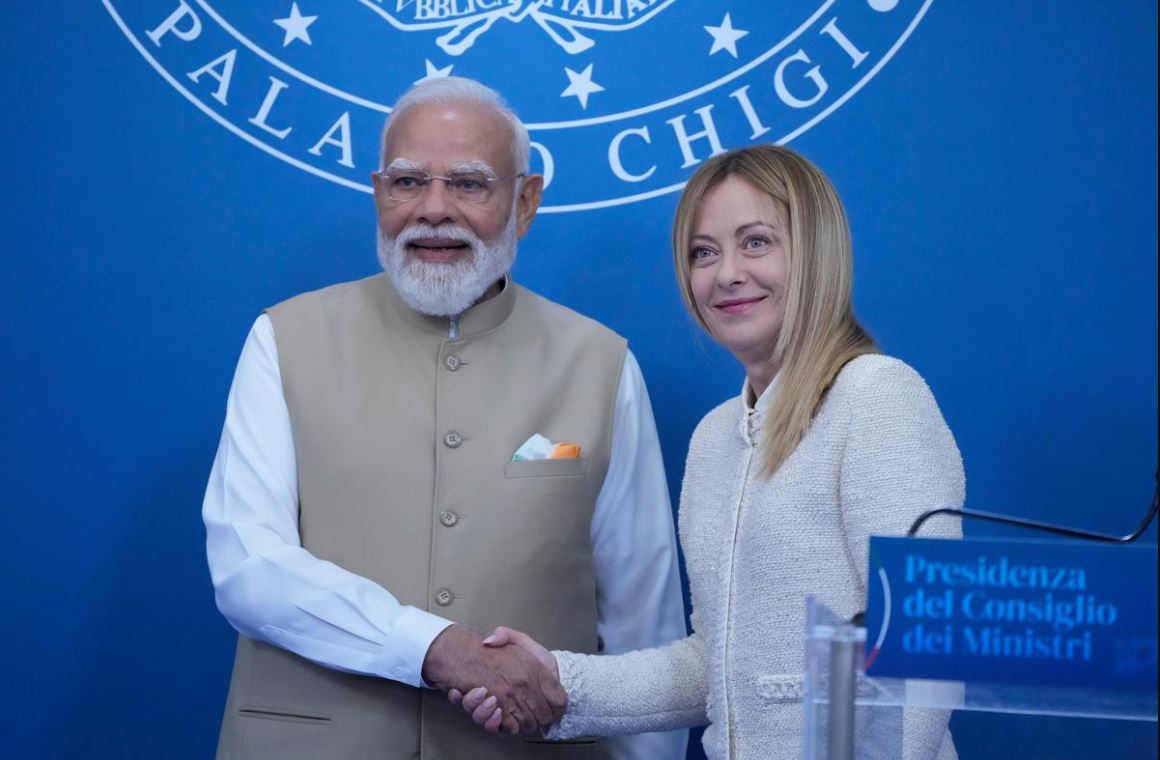
Prime Minister Narendra Modi announced the elevation of India-Italy ties to a "Special Strategic Partnership" after holding bilateral talks with Italian Prime Minister Giorgia Meloni in Rome. "India and Italy are elevating ties to a Special Strategic Partnership. India-Italy relations are now capable of realising their fullest potential," PM Modi said.
The visit is Modi's first bilateral visit to Italy after participating in the G7 summit in Borgo Egnazia in June 2024 and the G20 in Rome in October 2021. It is also the first official mission to Rome by an Indian prime minister in 26 years.
Meloni called it the highest level ever reached between the two countries, crediting the progress to her seven meetings with Modi over the past three and a half years, saying the two leaders have developed an honest friendship built on mutual respect and trust.
From a Cordial Friendship to a Special Strategic Partnership
Modi and Meloni described the relationship as having gathered "unprecedented momentum" in recent years, evolving from a cordial friendship into a special strategic partnership grounded in the values of freedom and democracy. The two leaders placed people at the centre of this approach.
In a joint op-ed titled "Italy and India: A Strategic Partnership for the Indo-Mediterranean," the two leaders wrote: "Our cooperation mirrors our shared awareness that prosperity and security in the 21st century will be shaped by the ability of nations to innovate, manage energy transitions, and strengthen strategic sovereignty."
Key pillars driving the upgraded partnership:
- The cooperation agenda now spans defence, scientific research, trade, investment, human-centric artificial intelligence, counterterrorism, and the fight against human trafficking
- More than 1,000 Indian and Italian firms now operate in each other's markets across manufacturing, services, and infrastructure
- Agreements were signed covering maritime transport, agriculture, higher education, critical minerals, museum cooperation, and the fight against economic and financial crime
Trade, Technology, and the Euro 20 Billion Target
The two leaders set a concrete trade target: "We want to reach and exceed the Euro 20 billion target for trade between Italy and India by 2029, with a focus on defence and aerospace, clean technologies, machinery, automotive components, chemicals, pharmaceuticals, textiles, agri-food, tourism and more."
Modi and Meloni outlined an ambition to combine Italy's industrial and design legacy with India's scale, engineering talent, and innovation ecosystem, aiming to forge synergy between Italian design, manufacturing excellence, and world-class supercomputers alongside India's rapid economic growth and entrepreneurial ecosystem with over 100 unicorns and 200,000 startups.
On emerging technology, both governments highlighted:
- Plans for cooperation in artificial intelligence, quantum computing, advanced manufacturing, and digital infrastructure
- A commitment to human-centric AI, building on India's vision of MANAV and Italy's "algor-ethics" rooted in its humanist tradition, ensuring AI acts as a catalyst for social empowerment
- Both nations see AI as a tool for the Global South, where accessible, multilingual digital infrastructure can close gaps rather than widen them
IMEC, Defence, and the Indo-Mediterranean Vision
The op-ed underscored support for the India-Middle East-Europe Economic Corridor (IMEC), describing it as a transformative vision linking transport, digital networks, energy systems, and resilient supply chains between Asia, the Middle East, and Europe.
Like other European countries, Italy has looked to India as an ally during a period of geopolitical upheaval. The European Union earlier this year concluded a long-delayed trade deal with India, partly aimed at reducing its reliance on the United States.
Defence cooperation has moved sharply beyond a buyer-seller dynamic:
- Co-design, co-development, and co-production are the defining themes of the 2026-27 bilateral Military Cooperation Plan
- Italian expertise in naval systems, aerospace technologies, defence electronics, propulsion systems, shipbuilding, and advanced engineering can complement India's manufacturing ecosystem under Atmanirbhar Bharat
- India and Italy are also preparing to launch their first Maritime Security Dialogue to further strengthen cooperation across maritime domains
Energy, Culture, and Civilisational Convergence
On energy, Modi and Meloni highlighted growing collaboration in renewable energy, green hydrogen, smart grids, and sustainable infrastructure, alongside joint participation in initiatives such as the International Solar Alliance, the Coalition for Disaster Resilient Infrastructure, and the Global Biofuels Alliance.
Geographically, the two leaders argued that India and Italy sit at the intersection of two critical global corridors, the Indo-Pacific and the Mediterranean, regions they described as "increasingly interconnected spaces."
Invoking civilisational themes, the two leaders said India's concepts of "Dharma" and "Vasudhaiva Kutumbakam" resonate strongly with Italy's Renaissance-era humanist traditions. "Our shared vision aims to lay the foundation for a strong and forward-looking India-Italy Partnership with our people at the centre," they added.
Why This Partnership Matters for India's European Strategy
Rome increasingly understands that the future of European competitiveness, economic resilience, and strategic diversification will depend upon trusted industrial partnerships beyond the continent, and India stands out because of its democratic credentials, scale, demographic dynamism, manufacturing ambitions, and expanding geopolitical role.
Meloni and Modi also discussed major international issues including the Middle East, Ukraine, and security in the Indo-Pacific. The Rome visit, coming as the final leg of Modi's five-nation European tour, signals that India is no longer treating Europe as a single diplomatic bloc but is investing in deep, bilateral relationships with individual partners that carry strategic weight.
The India-Italy relationship is becoming a test case for how India and Europe can build trusted industrial, technological, and strategic partnerships in an age of uncertainty. To sustain this momentum, both sides must institutionalise investment facilitation, accelerate defence-industrial cooperation, deepen mobility arrangements, support innovation ecosystems, and move quickly to take advantage of the India-EU FTA.