There is a distinction worth making at the outset. When a defence contractor reports record profits, the instinct in financial media is to treat it as a corporate story. At BAE Systems, the numbers tell a geopolitical story first and a financial one second. Understanding the difference matters if you want to understand what is driving the most sustained expansion in Western defence procurement since the Cold War.
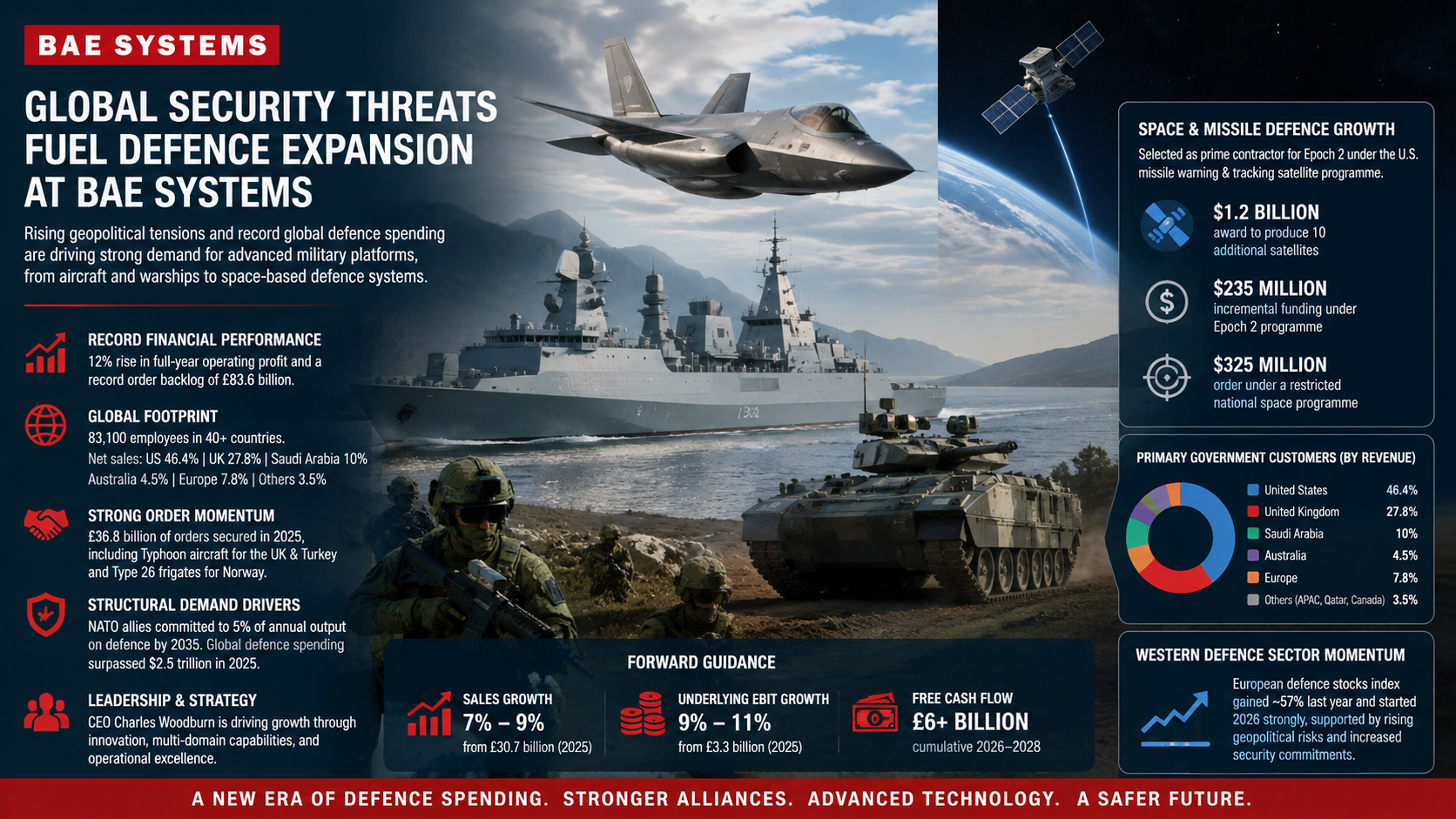
BAE Systems has described the current environment as a "new era" of defence spending, driven by escalating security challenges, reporting a 12% rise in full-year operating profit and a record order backlog of £83.6 billion. That backlog is not an accounting abstraction. It represents contracted sovereign demand from governments that have concluded they are not adequately protected.
Who Is BAE Systems and Who Does It Serve
BAE Systems provides some of the world's most advanced technology-led defence, aerospace, and security solutions, employing a skilled workforce of approximately 83,100 people in over 40 countries. Its customer base spans NATO governments, Indo-Pacific partners, and Middle Eastern states, making it one of the few Western contractors with genuine multi-theatre exposure.
Net sales are distributed geographically as follows: the United Kingdom at 27.8%, the United States at 46.4%, Saudi Arabia at 10%, Australia at 4.5%, Europe at 7.8%, and smaller shares across Asia-Pacific, Qatar, and Canada. That geographic spread insulates BAE from dependency on any single government's budget cycle, which is a structural advantage that pure-play domestic contractors cannot replicate.
Who Is Ordering and Why the Demand Is Structural
The order volumes BAE is recording are not the product of a procurement surge that will normalise once a specific conflict resolves. They reflect a recalibration of national security doctrine across multiple regions simultaneously.
In 2025, BAE secured £36.8 billion of orders. Highlights included a £4.6 billion deal between the UK and Turkey for 20 Typhoon aircraft and an associated weapons package, as well as a £10 billion agreement with Norway's government to provide Type 26 frigates for its warship programme.
NATO allies have committed to spend five percent of annual output on defence by 2035, with European members also facing pressure from US President Donald Trump to bolster defence spending. That political pressure has translated into binding procurement commitments, not aspirational budget statements, which is what separates the current cycle from previous post-Cold War spending pledges that largely went unfulfilled.
Global defence spending reached an all-time high in 2025, surpassing $2.5 trillion. The ongoing conflict in Ukraine, renewed NATO commitments, and modernisation programmes across the United States and Asia-Pacific continue to drive demand for advanced air, land, and naval platforms.
Who Is Leading BAE and What the Forward Guidance Signals
Chief Executive Charles Woodburn stated that geographic breadth, proven multi-domain capabilities, and a focus on operational excellence and innovation are enabling consistent delivery of critical programmes, adding that the company is well positioned for both current and future opportunities in defence.
BAE Systems is expecting a constant currency sales rise of between 7% and 9% from its 2025 base of £30.7 billion, and a 9% to 11% rise in underlying earnings before interest and tax from £3.3 billion.
The company expects cumulative free cash flow between 2026 and 2028 in excess of £6 billion. For a company operating in long-cycle government contracts, that degree of cash flow visibility over a multi-year horizon is rare and reflects the depth of its existing committed order book.
Who Is Funding the Space and Missile Defence Segment
One of the least discussed but most consequential growth vectors for BAE is its position in space-based defence architecture. This segment is being driven by the United States' push to construct layered missile defence infrastructure.
In June 2025, BAE Systems was selected as the prime contractor for Epoch 2 under the missile warning and tracking satellite programme, receiving a $1.2 billion award to produce 10 additional satellites. The Space and Mission Systems business subsequently received approximately $235 million in incremental funding under the Epoch 2 programme and a further $325 million order under a restricted national space programme.
This trajectory connects BAE directly to the United States' Golden Dome missile defence initiative, a programme that is expected to generate sustained multi-year contract flows for prime contractors with established space systems credentials.