Blood Moon Lunar Eclipse 2026:
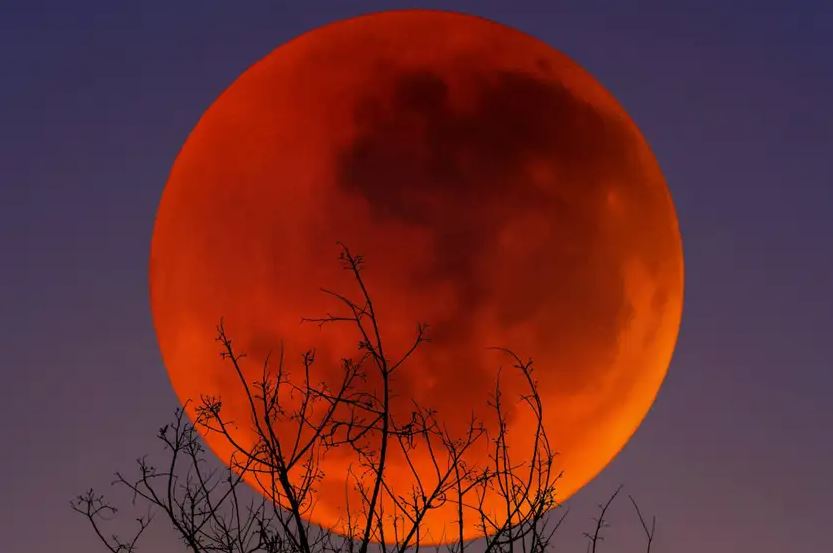
On March 3, 2026, Earth, the Sun, and the Moon aligned perfectly for the first time in over a year, casting our planet's shadow across the entire lunar surface and turning the Moon a deep coppery red for 58 to 59 minutes. This is the only total lunar eclipse of 2026 and the last one visible to most of the world until New Year's Eve 2028.
WHO SAW THE BLOOD MOON AND FROM WHERE
Who Could See the Full Blood Moon on March 3, 2026
More than 3 billion people were positioned on the night side of Earth during totality, making this one of the most widely observed astronomical events in years. The entire eclipse, from the first penumbral shading through totality and back out, was visible to observers across the easternmost parts of Asia, eastern Australia, New Zealand, and the Pacific region. Early risers in North and Central America and far western South America could see totality before dawn on March 3, 2026. For viewers in eastern Asia and Australia, totality unfolded in the evening sky on March 3, 2026, making it unusually convenient for casual observation without requiring a late night or an early alarm.
In the United States, totality began at 6:04 AM Eastern Time on March 3, 2026, reached peak redness at 6:33 AM Eastern Time, and ended at 7:03 AM Eastern Time. The partial eclipse ended at 8:17 AM Eastern Time, and the entire event concluded by 9:23 AM Eastern Time. For viewers in India, the eclipse unfolded between approximately 2:34 PM IST and 7:23 PM IST on March 3, 2026, with totality visible between approximately 4:34 PM IST and 5:33 PM IST.
For observers in New Zealand, the Moon turned red after midnight on March 4, 2026, local time.
Who Missed the Eclipse and Why
Africa, Europe, most of western Asia, and the majority of South America east of the Andes did not see the eclipse at all. A lunar eclipse, unlike a solar eclipse, does not have a narrow path of totality across Earth's surface. Instead, the full eclipse is visible from anywhere the Moon is above the horizon during the event. Because the Moon was below the horizon for Africa and Europe during the March 3, 2026, totality window, observers in those regions missed the event entirely and will need to wait until the December 31, 2028, to January 1, 2029, eclipse for their next opportunity.
WHAT CAUSES THE MOON TO TURN RED: THE SCIENCE OF RAYLEIGH SCATTERING
What a Total Lunar Eclipse Actually Is
A total lunar eclipse occurs when Earth moves directly between the Sun and the Moon in a precise alignment called syzygy. During this alignment, Earth casts two distinct shadow zones into space. The outer, lighter shadow is called the penumbra. The inner, darker shadow is called the umbra. A total lunar eclipse, and therefore a Blood Moon, only occurs when the Moon passes fully into the umbra, the darkest part of Earth's shadow. A penumbral eclipse, in which the Moon only passes through the outer shadow, produces only a subtle dimming that is barely noticeable to the naked eye. A partial lunar eclipse occurs when the Moon passes through part of the umbra but not fully.
This alignment can only happen during a full Moon phase, because the Moon must be on the exact opposite side of Earth from the Sun for Earth's shadow to fall across the lunar surface. However, it does not happen every full Moon because the Moon's orbital path is tilted approximately 5.1 degrees relative to Earth's orbital plane around the Sun. The Moon therefore usually passes slightly above or below Earth's shadow. A total lunar eclipse only occurs when the Moon crosses a specific point called a node, where its orbital path intersects Earth's orbital plane, at the same time it is directly opposite the Sun. Because this precise alignment does not occur frequently, total lunar eclipses happen on average only about once every two and a half years for any given location on Earth.
What Rayleigh Scattering Is and Why It Makes the Moon Red
The red color of a Blood Moon is not a property of the lunar surface itself. It is an optical phenomenon caused entirely by the behavior of light passing through Earth's atmosphere. The process responsible is called Rayleigh scattering, named after the British physicist Lord Rayleigh, who described it in the 1870s.
Sunlight appears white to the human eye but is actually composed of all the colors of the visible spectrum, each with a different wavelength. Colors toward the violet and blue end of the spectrum have short wavelengths. Colors toward the red and orange end of the spectrum have long wavelengths. When sunlight enters Earth's atmosphere, it collides with gas molecules in the air. These collisions scatter light in all directions. Because blue light has a short wavelength, it collides more frequently with atmospheric molecules and scatters more readily. This is why the sky appears blue during the day: scattered blue light reaches the observer's eyes from every direction.
During a total lunar eclipse, the Moon sits entirely within Earth's umbra. No direct sunlight reaches the Moon. However, Earth's atmosphere acts as a lens, bending and filtering sunlight around the edge of Earth and redirecting a small amount onto the lunar surface. The light that gets through this atmospheric filter has traveled along the edge of Earth's atmosphere, passing through the thickest, warmest, most densely packed layers of air. By the time it emerges on the other side, almost all of the short-wavelength blue and violet light has been scattered away. What remains is predominantly long-wavelength red and orange light, which bends around Earth's curvature and reaches the Moon's surface.
The result is that the Moon, instead of going completely dark during totality, glows in shades of deep red, copper, orange, and rust. NASA's description of the effect captures it precisely: it is as if all of the world's sunrises and sunsets are projected simultaneously onto the Moon's surface. If you were standing on the lunar surface during totality on March 3, 2026, and looked back at Earth, you would see a dark planet ringed by a thin, glowing halo of red and orange light, the combined glow of every sunrise and sunset on Earth at that exact moment.
What Affects the Specific Color and Darkness of the Blood Moon
Not every Blood Moon looks the same. The specific shade of red, how deeply crimson or how faintly orange the Moon appears during totality, depends on the current state of Earth's atmosphere along the eclipse path. Astronomers use the Danjon Scale, a five-level system developed by French astronomer Andre-Louis Danjon, to describe the brightness and color of a total lunar eclipse.
On the Danjon Scale, a rating of 0 describes an almost invisible Moon at mid-totality, typically associated with major volcanic eruptions that have loaded the stratosphere with light-blocking ash. A rating of 4 describes a very bright copper-red or orange Moon with a bluish, bright rim. The March 3, 2026, eclipse was expected to produce a rating of approximately 3 to 4 based on stable atmospheric conditions globally. Observers who followed the event reported a vivid rust and copper color consistent with a clean, relatively unobstructed atmosphere.
Volcanic eruptions that inject sulfur dioxide and ash into the stratosphere can dramatically darken a Blood Moon, sometimes producing the near-invisible eclipses described at the lower end of the Danjon Scale. Dust from large wildfires, widespread industrial pollution, and even high-altitude humidity can also affect the color, making the Moon appear darker or more orange than it would under pristine atmospheric conditions. In this sense, the Blood Moon of March 3, 2026, functioned as a real-time diagnostic of the health and transparency of Earth's atmosphere.
What Happens to the Moon's Temperature During Totality
One aspect of a total lunar eclipse that most casual observers do not know is the extreme thermal violence occurring on the lunar surface during totality. Because the Moon has no atmosphere to moderate its temperature, the sudden removal of direct sunlight during totality causes a rapid and dramatic cooling of the lunar surface. In the roughly 58 to 59 minutes of totality on March 3, 2026, the surface temperature of the Moon dropped by several hundred degrees Fahrenheit in the areas entering Earth's shadow. This thermal shock, far more rapid than a standard lunar sunset, stresses the surface regolith and has been studied by NASA as a mechanism for understanding the physical properties of the lunar soil.
WHAT THE THREE TYPES OF LUNAR ECLIPSE ARE AND HOW THEY DIFFER
Who Defined the Three Eclipse Types
The scientific classification of lunar eclipses into three distinct types, penumbral, partial, and total, is rooted in the geometry of Earth's shadow in space and has been refined through centuries of astronomical observation. Understanding the difference between them matters because only a total lunar eclipse, in which the Moon passes entirely into Earth's umbra, produces the Blood Moon effect.
A penumbral eclipse is the most common and least dramatic. The Moon passes through only the outer, diffuse shadow of Earth, called the penumbra. The Moon loses some brightness, but the change is subtle enough that many observers do not notice it without knowing in advance that an eclipse is occurring.
A partial eclipse occurs when the Moon passes through part of Earth's umbra but is not fully immersed. Part of the Moon appears bitten or darkened, while the rest remains in full sunlight. No red color is visible during a partial eclipse.
A total eclipse occurs when the Moon passes completely into Earth's umbra. This is when Rayleigh scattering takes full effect and the Moon glows red. The March 3, 2026, eclipse was a total eclipse, which is why the full Blood Moon effect was visible to billions of observers worldwide.
WHAT THE BLOOD MOON MEANS IN HISTORY, CULTURE, AND SCIENCE
Who Named It a Blood Moon and When
The term "Blood Moon" is not a scientific designation. It is a popular term that entered widespread modern use around 2014, primarily through the work of American pastors John Hagee and Mark Biltz, who connected a series of four consecutive total lunar eclipses, known as a lunar tetrad, to biblical prophecy in the books of Joel and Revelation. The astronomical term for that sequence is a lunar tetrad. The label "Blood Moon" predates that 2014 resurgence, however, and appears in older cultural and religious traditions across multiple civilizations.
Ancient cultures around the world developed their own interpretations of total lunar eclipses. The ancient Greeks correctly deduced the basic geometry of lunar eclipses by observing Earth's curved shadow on the Moon's surface, a key piece of early evidence that Earth was spherical. Ancient Mesopotamian astronomers were meticulous eclipse observers and connected lunar eclipses to portents for their rulers. The Incas believed a jaguar was attacking and eating the Moon during totality, and would make loud noises and wave spears at the sky to frighten the jaguar away. The Mayans referred to a reddened Moon with terms connected to tearing or wounding.
Today, scientists fully understand that a total lunar eclipse is a predictable consequence of orbital mechanics. NASA can calculate the exact time, duration, and visibility of every lunar eclipse centuries in advance. The March 3, 2026, eclipse was predicted to the second. None of the ancient fear or uncertainty applies. Yet billions of people still went outside to watch it, which tells us something about the enduring hold that large-scale astronomical events have on human attention and imagination.
Who Observed the March 3, 2026, Eclipse and What They Saw
Observers across western North America, Australia, New Zealand, and eastern Asia reported clear skies for most of the totality window. Space.com's live coverage team described the Blood Moon as visible to billions across the Americas, Asia, and Oceania, with the Moon slowly shifting from its normal bright gray through shades of orange and rust before settling into the deep coppery red of maximum totality at 11:33 AM UTC on March 3, 2026. Photographs taken from around the world showed a Moon with a vivid brick-red to copper coloration consistent with a Danjon Scale rating of 3 to 4.
During totality, NASA noted that the Moon was positioned in the constellation Leo, under the lion's hind paws. Observers who allowed their eyes to adjust to the darkened sky reported that the reduced brightness of the fully eclipsed Moon made it significantly easier to see surrounding stars and constellations that are normally washed out by the full Moon's glare.
WHAT COMES NEXT: THE ECLIPSE CALENDAR THROUGH 2029
Who Missed the March 3, 2026, Eclipse and When They Can See the Next One
For observers in Africa, Europe, and most of South America who missed the March 3, 2026, Blood Moon entirely, the next total lunar eclipse will occur on December 31, 2028, to January 1, 2029. That eclipse has been described as the New Year's Blood Moon Eclipse, and it will be visible from a different geographic distribution than the March 2026 event. A partial lunar eclipse is expected in August 2026, but it will not produce the red Blood Moon coloration associated with totality.
The March 3, 2026, eclipse was the second eclipse of the current eclipse season. The first was the annular solar eclipse of February 17, 2026, which produced the ring of fire effect visible from a narrow path across Earth's surface. Solar and lunar eclipses typically occur in pairs within the same two-week window because the same orbital geometry that produces a solar eclipse, the Moon crossing a node near the Sun, also produces a lunar eclipse approximately two weeks later when the Moon reaches the opposite node.