
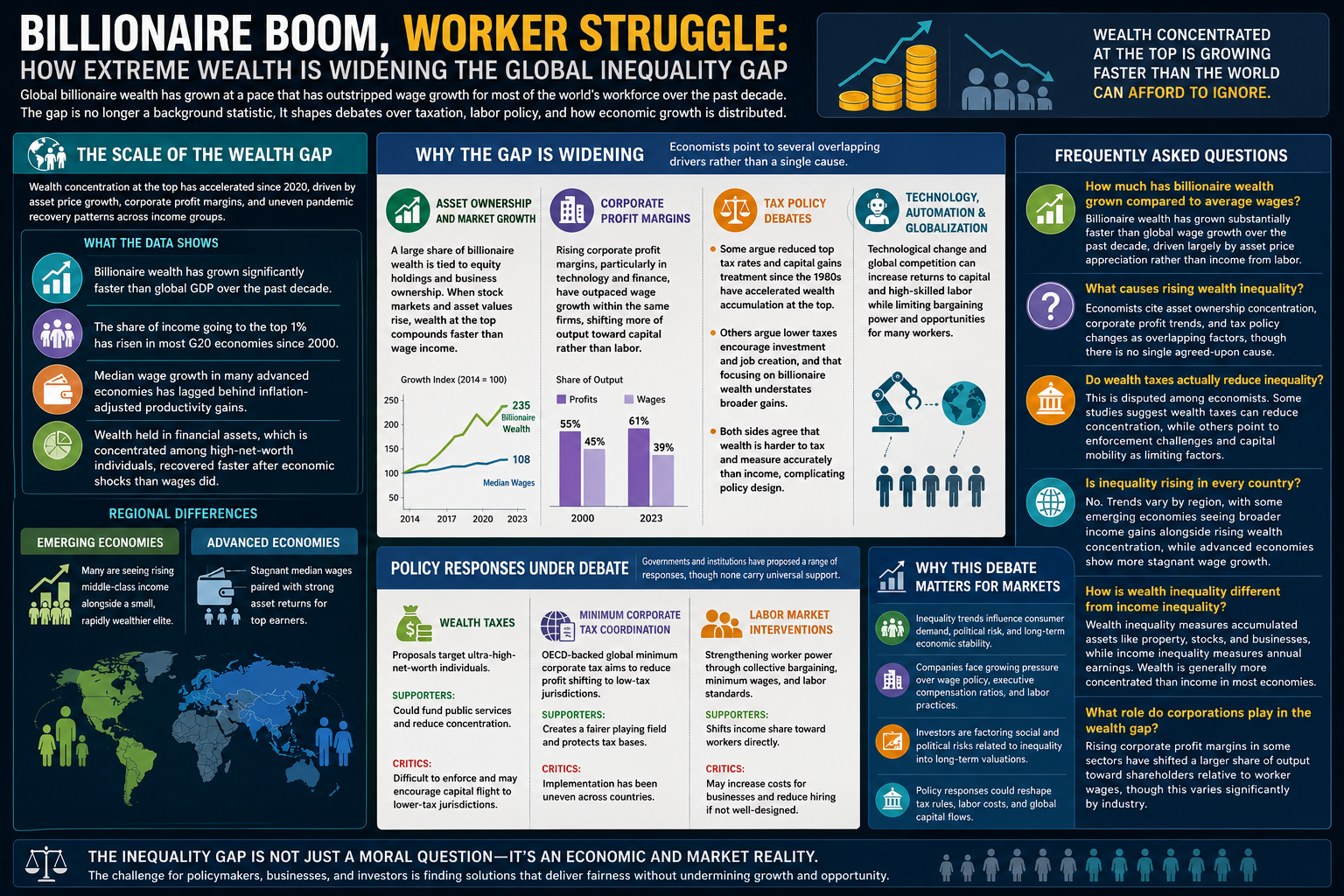
Global billionaire wealth has grown at a pace that has outstripped wage growth for most of the world's workforce over the past decade. The gap is no longer a background statistic. It shapes debates over taxation, labor policy, and how economic growth is distributed.
This report examines the data behind the trend, the competing explanations for it, and what economists disagree on when it comes to solutions.
The Scale of the Wealth Gap
Wealth concentration at the top has accelerated since 2020, driven by asset price growth, corporate profit margins, and uneven pandemic recovery patterns across income groups.
What the Data Shows
Recent inequality tracking indicates a consistent pattern across major economies:
- Billionaire wealth has grown significantly faster than global GDP over the past decade.
- The share of income going to the top 1 percent has risen in most G20 economies since 2000.
- Median wage growth in many advanced economies has lagged behind inflation-adjusted productivity gains.
- Wealth held in financial assets, which is concentrated among high-net-worth individuals, recovered faster after economic shocks than wages did.
Regional Differences
Inequality trends are not uniform. Some emerging economies have seen rising middle-class income alongside a small, rapidly wealthier elite, while several advanced economies have seen stagnant median wages paired with strong asset returns for top earners.
Why the Gap Is Widening
Economists point to several overlapping drivers rather than a single cause.
Asset Ownership and Market Growth
A large share of billionaire wealth is tied to equity holdings and business ownership. When stock markets and asset values rise, wealth concentrated at the top compounds faster than wage income, which grows more slowly and is subject to inflation and labor market pressure.
Corporate Profit Margins
Some economists argue that rising corporate profit margins, particularly in technology and finance, have outpaced wage growth within the same firms, shifting a greater share of output toward capital rather than labor.
Tax Policy Debates
Tax policy is one of the most contested factors in this discussion.
- Some economists argue that reduced top marginal tax rates and capital gains treatment since the 1980s have allowed wealth to accumulate faster at the top.
- Others argue that lower taxes on capital encourage investment and job creation, and that focusing on billionaire wealth understates broader gains in living standards.
- Both sides generally agree that wealth data is harder to tax and measure accurately than income data, which complicates policy design.
Policy Responses Under Debate
Governments and institutions have proposed a range of responses, though none carry universal support among economists.
Wealth Taxes
Several countries and international bodies have discussed coordinated wealth tax proposals targeting ultra-high-net-worth individuals. Supporters argue this could fund public services and reduce concentration. Critics argue wealth taxes are difficult to enforce and may encourage capital flight to lower-tax jurisdictions.
Minimum Corporate Tax Coordination
The OECD-backed global minimum corporate tax framework represents one attempt to reduce profit shifting to low-tax jurisdictions, though implementation has been uneven across participating countries.
Labor Market Interventions
Some economists favor strengthening labor bargaining power and minimum wage policy as a more direct way to shift income share toward workers, rather than taxing accumulated wealth after the fact.
Why This Debate Matters for Markets
Inequality trends increasingly influence corporate strategy and investor sentiment. Companies face growing pressure over wage policy, executive compensation ratios, and supply chain labor practices, while policymakers weigh how redistribution measures could affect investment and growth.