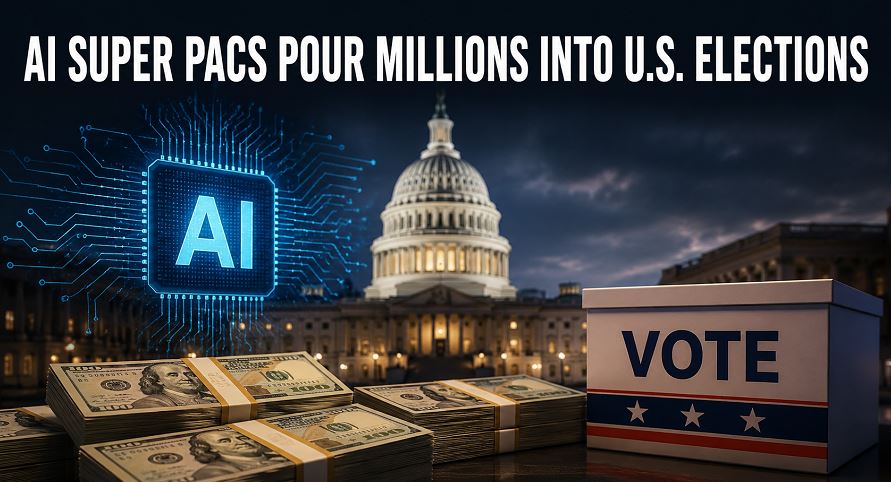
Artificial intelligence is no longer just reshaping economies and workplaces. It is now actively reshaping American elections. Ahead of the 2026 midterm elections, a wave of super PACs backed by Silicon Valley's most powerful companies and investors is pouring hundreds of millions of dollars into congressional races, making AI regulation one of the defining battlegrounds of this political cycle. The scale of the spending, and the ideological split within the industry itself, is without precedent in the brief history of AI as a political force.
How Much Money Is Flowing and Where It Is Going
Super PACs funded by the cryptocurrency and artificial intelligence industries have amassed more than $321 million in the 2026 cycle, according to a review of Federal Election Commission filings, as they spend millions to knock out candidates they deem unsupportive of industry-favored regulation. The sums rival the spending power of the giant super PACs traditionally controlled by Democratic and Republican party leadership.
Leading the Future, a super PAC that launched in 2025 with support from AI companies, has raised $15 million in the first quarter of 2026 alone, bringing its total haul for the election season to $140 million. Its backers include venture capital firm Andreessen Horowitz, OpenAI co-founder Greg Brockman, Palantir co-founder Joe Lonsdale, SV Angel founder Ron Conway, and AI software company Perplexity.
On the other side of the debate, a network called Public First is pledging $50 million to candidates who support AI regulation in either party, positioning itself as representing voters with concerns about the impacts of AI on children, workers, consumers, and the American economy.
Key facts about AI PAC spending in the 2026 cycle:
- The over $321 million raised spans 14 federal and state super PACs bankrolled by AI and crypto companies, with a Republican-focused nonprofit called Innovation Council Action pledging an additional $100 million in midterm contests.
- OpenAI co-founder Greg Brockman and his wife each contributed $12.5 million to Leading the Future, while Marc Andreessen and Benjamin Horowitz each personally gave $12.5 million.
- The money is being spent to elect lawmakers who support a single national AI framework that would block states from enacting stricter regulations, which backers argue is necessary for the United States to remain competitive with China.
- Anthropic self-reported a $20 million donation to Public First Action, a bipartisan nonprofit whose aligned super PACs are backing candidates who support regulatory oversight of the industry.
The Regulatory Battle at the Heart of the Spending
The contest between these super PACs reflects a genuine and consequential policy dispute over who gets to govern AI in America. Leading the Future supports candidates who favor AI-friendly policies, attacks candidates who call for stricter regulations, and backs policies that prioritize AI growth, while former U.S. Representatives Chris Stewart and Brad Carson created two pro-regulation super PACs to counter the influence of pro-AI groups founded by Andreessen Horowitz, OpenAI, Meta, and other tech companies.
The spending has already had measurable effects on individual races. In the crowded Democratic primary for New York's 12th Congressional District, the AI industry has already spent more than $2.4 million to defeat state Assemblymember Alex Bores, the candidate who authored one of the nation's first major AI safety bills. A PAC associated with Anthropic-supported Public First Action is supporting Bores, while Leading the Future is not, with a spokesperson calling him a candidate pushing policies that would undermine America's ability to lead the world in AI innovation.
Bores told NOTUS that the spending by Leading the Future is unsurprising because the return for donors could be worth trillions, making $100 million appear more like a venture capital investment than a political donation.
What Voters and Critics Are Saying
The public reception to AI political spending is not uniformly positive. A coalition of groups led by The Tech Oversight Project sent a letter to lawmakers arguing that Leading the Future and super PACs like it have emerged as the well-funded mouthpiece of the Big Tech AI industry, trying to whitewash its role in rising energy prices, executive overreach, and deadly harms to children and teenagers.
Tiffany Muller, president of End Citizens United, has stated that AI-aligned super PACs are not showing up in races by accident, but are following signals and investing in elections because they expect a return on that investment.
The work of pro- and anti-AI super PACs to elect the candidates they want is growing more complex as the regulatory conversation shifts and voters grow increasingly wary of AI.