Who Traveled to Beijing and Why Corporate America Showed Up
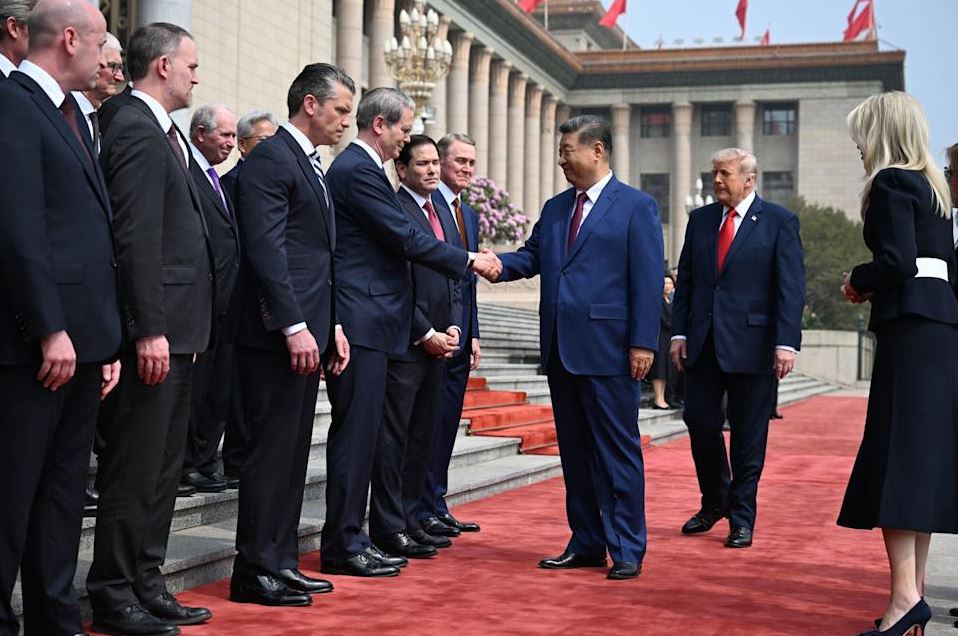
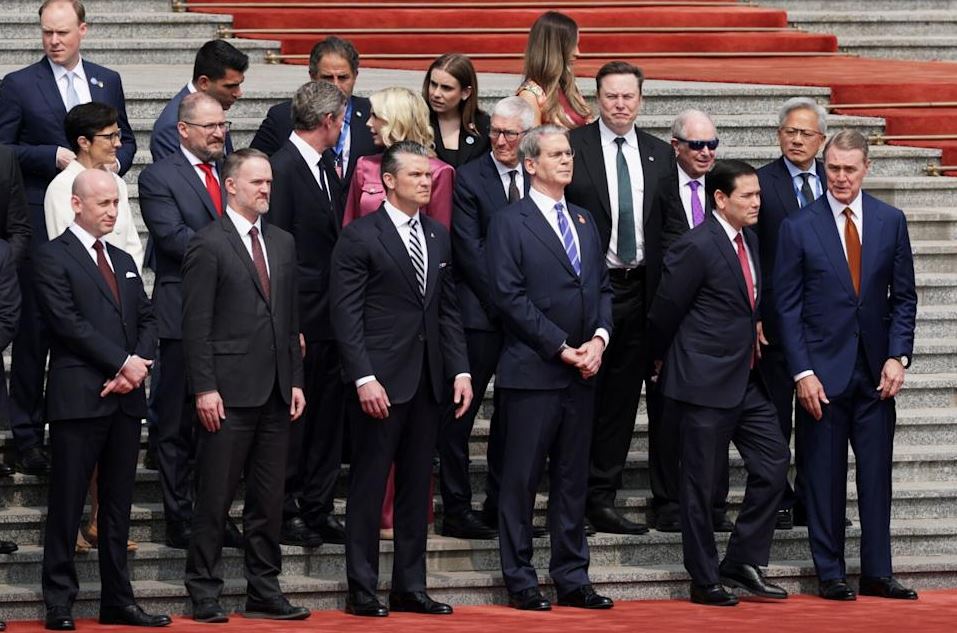
President Trump arrived in China alongside a delegation of billionaire U.S. executives, including Tesla CEO Elon Musk and Nvidia CEO Jensen Huang, underscoring the high stakes for American companies as Washington and Beijing negotiate over trade, artificial intelligence, and the Iran war.
The executives, whose combined net worth approaches $1 trillion, lead companies with major business interests in China, despite years of trade disputes between the world's two largest economies.
The full roster of executives on the trip included:
- Elon Musk, CEO of Tesla and SpaceX
- Jensen Huang, CEO of Nvidia
- Tim Cook, CEO of Apple
- Kelly Ortberg, CEO of Boeing
- Larry Fink, Chairman and CEO of BlackRock
- Jane Fraser, Chairman and CEO of Citigroup
- David Solomon, CEO of Goldman Sachs
- Stephen Schwarzman, CEO of Blackstone
- Leaders from Meta, Mastercard, Visa, Qualcomm, Micron, Cargill, Cisco, GE Aerospace, and Illumina, totaling 17 executives
Upon arrival, Trump introduced the group by telling Xi that they were "distinguished representatives from the American business community" who "all respect and value China." The group told Xi they "highly value the Chinese market" and hope to do more business in the country.
What Each CEO Was Seeking at the Beijing Summit
The presence of Huang, Musk, Cook, and others signals that technology and commerce are among the top U.S. priorities going into the meetings, according to Dan Ives of Wedbush Securities, who noted that what is at stake is "not just one trip or one headline but the direction of AI supply chains, the shape of future export controls, and the degree to which US chip leadership remains monetizable in China."
Here is what each major CEO was pursuing:
NVIDIA (Jensen Huang): Huang is in Beijing, hoping to unlock stalled efforts to sell the company's H200 chips in China. In January, the Trump administration greenlit the export of H200 AI chips to China but placed new security requirements on Nvidia's sales to the country. Reports emerged during the summit that Nvidia had received the green light from the U.S. to sell its H200 chip to China, though Treasury Secretary Scott Bessent said the news came as a surprise to him.
Tesla (Elon Musk): China is a critical market for Tesla's electric vehicle business, and Musk is currently seeking clearance from Chinese regulators to expand adoption of Tesla's Full Self-Driving assistance system. Tesla's Shanghai factory reported total sales of 292,876 vehicles in the first four months of 2026, up 26.7 percent year-on-year. Musk is also reported to be seeking to procure solar panel manufacturing equipment from Chinese suppliers worth approximately $2.9 billion.
Apple (Tim Cook): Apple sells more than 60 million iPhones in the U.S. each year, with roughly 80 percent of them made in China. Cook managed previous tariff exposure by shifting production of U.S.-bound iPhones to India while committing $100 billion in U.S. investments. The summit gave Cook an opportunity to lobby for a calmer regulatory and tariff environment for Apple's China-dependent supply chain.
Boeing (Kelly Ortberg): Bloomberg reported that China was considering buying about 500 Boeing 737 MAX jetliners, as well as about 100 Boeing 787 Dreamliner and 777X wide-body jets. Ortberg expressed confidence that a deal between Trump and Xi would "include some aircraft orders."
Wall Street (Fink, Fraser, Solomon, Schwarzman): Other tech and finance executives are eyeing opportunities to set up a proposed Board of Trade and Board of Investment with China, a mechanism to manage trade relations between the two countries in non-sensitive commercial areas.
What Deals and Commitments Came Out of the Summit
President Trump told Fox News that Xi agreed to purchase soybeans, energy, and jets during the two leaders' bilateral meeting in Beijing.
Purchase commitments on U.S. commodities, including soybeans, beef, and other agricultural products, as well as the completion of a long-delayed deal for China to buy up to 500 Boeing 737 MAX jets, are among the big wins expected to be announced by the administration.
Key structural outcomes from the corporate delegation's participation include:
- Xi told the assembled American CEOs that China's door would "open wider," with state media reporting that Xi welcomed the U.S. to "enhance mutually beneficial cooperation" and expressed belief that U.S. companies would "enjoy even broader prospects in China."
- The two countries agreed to forge more cooperative ties, striving to build a "constructive China-U.S. relationship of strategic stability" to serve as the guiding framework for the next three years and beyond
- The White House discussed the formation of a U.S.-China Board of Trade and a U.S.-China Board of Investment to provide structured government-to-government forums for managing commercial and investment-related issues
Jensen Huang called the Beijing summit "one of the most important summits in human history," though he declined to comment specifically on Nvidia's chip sales prospects in China