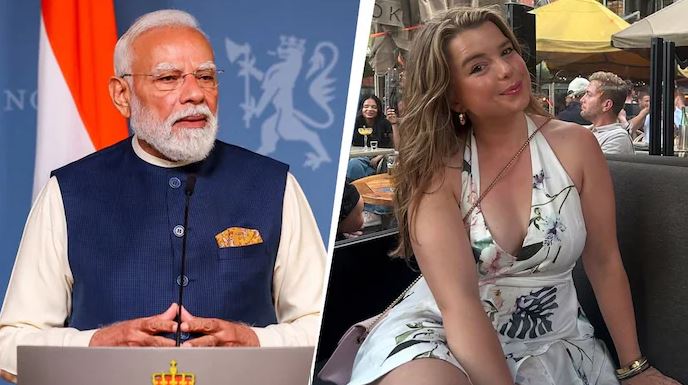
A brief, unanswered question shouted across a room in Oslo has done what months of diplomatic briefings could not: placed India's press freedom record at the centre of its European engagement. Norwegian journalist Helle Lyng called out to PM Modi as he exited the official joint media briefing with Norwegian Prime Minister Jonas Gahr Støre: "Why don't you take some questions from the freest press in the world?" The question went unanswered. The clip went viral. The debate it opened has not closed.
Who Is Helle Lyng and What Did She Ask?
Helle Lyng currently works as a commentator with Dagsavisen, an Oslo-based newspaper. She is not a peripheral figure in Norwegian media. She is known for covering political and public affairs stories and drew global attention after raising questions during the joint press interaction involving PM Modi and Norwegian PM Jonas Gahr Støre in Oslo.
What she attempted to ask was not obscure. At the separate media briefing organised by the Indian Embassy later that evening, Lyng pressed Indian representatives directly: "Why should we trust you? Can you promise you will stop the human rights violations that go on in your country? Will the prime minister start taking critical questions from the Indian press?"
Key facts about the incident:
- Lyng's question at the press appearance went entirely unanswered as Modi walked off stage with Norwegian PM Støre
- She posted on X that she was not expecting a response, citing Norway's number one ranking on the World Press Freedom Index and India's position at 157th
- The Indian Embassy in Norway publicly tagged Lyng on social media and invited her to a separate press briefing at the Radisson Blu Plaza hotel at 9:30 PM that evening
- The later interaction with Indian officials also turned tense
How Indian Officials Responded
The Indian government's response fell to MEA Secretary (West) Sibi George, and it was revealing in both content and tone. George strongly defended India's democratic system and media landscape, saying: "You ask a question, don't ask me to answer in a particular way." He highlighted India's constitutional protections, voting rights for women since independence, and the country's large multilingual media ecosystem.
When pressed on why Modi does not take direct press questions, George responded by impugning the questioner's knowledge: "We face these kinds of questions basically because of the lack of understanding of the person who asked the question," before pivoting to familiar talking points about 1.4 billion people, 900 million smartphones, soaring voter turnouts, and a "5,000-year-old pluralistic heritage."
The Press Freedom Data Behind the Moment
The numbers Lyng cited are not opinion. They are on record. India is 157th out of 180 countries in the 2026 World Press Freedom Index released by Reporters Without Borders on April 30, 2026. In the 2025 index, India was at 151st, making the current ranking a six-place drop.
The index is led by Norway, the Netherlands, Estonia, Denmark, and Sweden, the exact nations Modi spent the week courting for green energy investment and trade partnerships. The juxtaposition was unavoidable.
The RSF's findings on India are specific and structural:
- Rising violence against journalists, concentrated media ownership, and increasing political alignment among media outlets are cited as core drivers of the decline
- Anti-terror and colonial-era laws, including sedition and defamation laws, are increasingly being used against journalists
- India's political indicator ranking worsened from 155 to 160, while its economic environment ranking slipped to 144, reflecting increased pressure on independent media through funding and ownership structures
- For the first time in the index's history, over half of the world's countries now fall into the "difficult" or "very serious" categories for press freedom
The Incident in Its Geopolitical Context
The Oslo moment was not an isolated episode. The same press freedom concerns had surfaced days earlier during Modi's stop in The Hague, where Dutch Prime Minister Rob Jetten told local reporters that the Netherlands and other EU member states held concerns about developments in India under Modi's BJP, including press freedom and minority rights.
This is the structural tension at the heart of India's European engagement. The EU-India Free Trade Agreement, signed in January 2026, brought together two economies representing roughly a quarter of the world's population and 25% of global GDP. European leaders want the trade relationship. They also have electorates that expect them to raise rights concerns. The result is a diplomatic friction point that no amount of summit choreography can fully suppress.
Why This Incident Matters Beyond the Clip
One journalist shouting a question that goes unanswered is not, by itself, a diplomatic crisis. What it represents is harder to manage: a values gap between India and its new European partners that runs directly through every green partnership communique and every FTA press release.
The controversy quickly spilled into Indian domestic politics, with Leader of Opposition Rahul Gandhi writing: "When there is nothing to hide, there is nothing to fear. What happens to India's image when the world sees a compromised PM panic and run from a few questions?" Hours later, Lyng publicly asked Gandhi if he would be available for an interview, to which Gandhi replied that he was ready.
India currently ranks 157th out of 180 countries on the 2026 World Press Freedom Index, behind Palestine, the UAE, and Cuba, as Lyng pointedly noted. That ranking does not disappear because the summit produced 12 signed agreements. European publics read both documents.
The deeper strategic risk for New Delhi is not one unanswered question in Oslo. It is the pattern it represents: a diplomatic posture that treats accountability questions as hostile acts rather than standard features of democratic engagement with free-press nations. In a partnership with countries ranked in the world's top five for press freedom, that posture carries a cost.