The Silent Energy Crisis Powering AI Revolution
Every time you send a prompt to ChatGPT, generate an image with DALL-E, or run a large language model inference, you're consuming electricity on a scale most people never consider. AI workloads now represent 11-20% of total data center electricity use, with data center electricity demand growing 12% annually over the past five years. The infrastructure powering artificial intelligence has become one of the fastest-growing drivers of global electricity demand, reshaping energy grids and water systems worldwide.
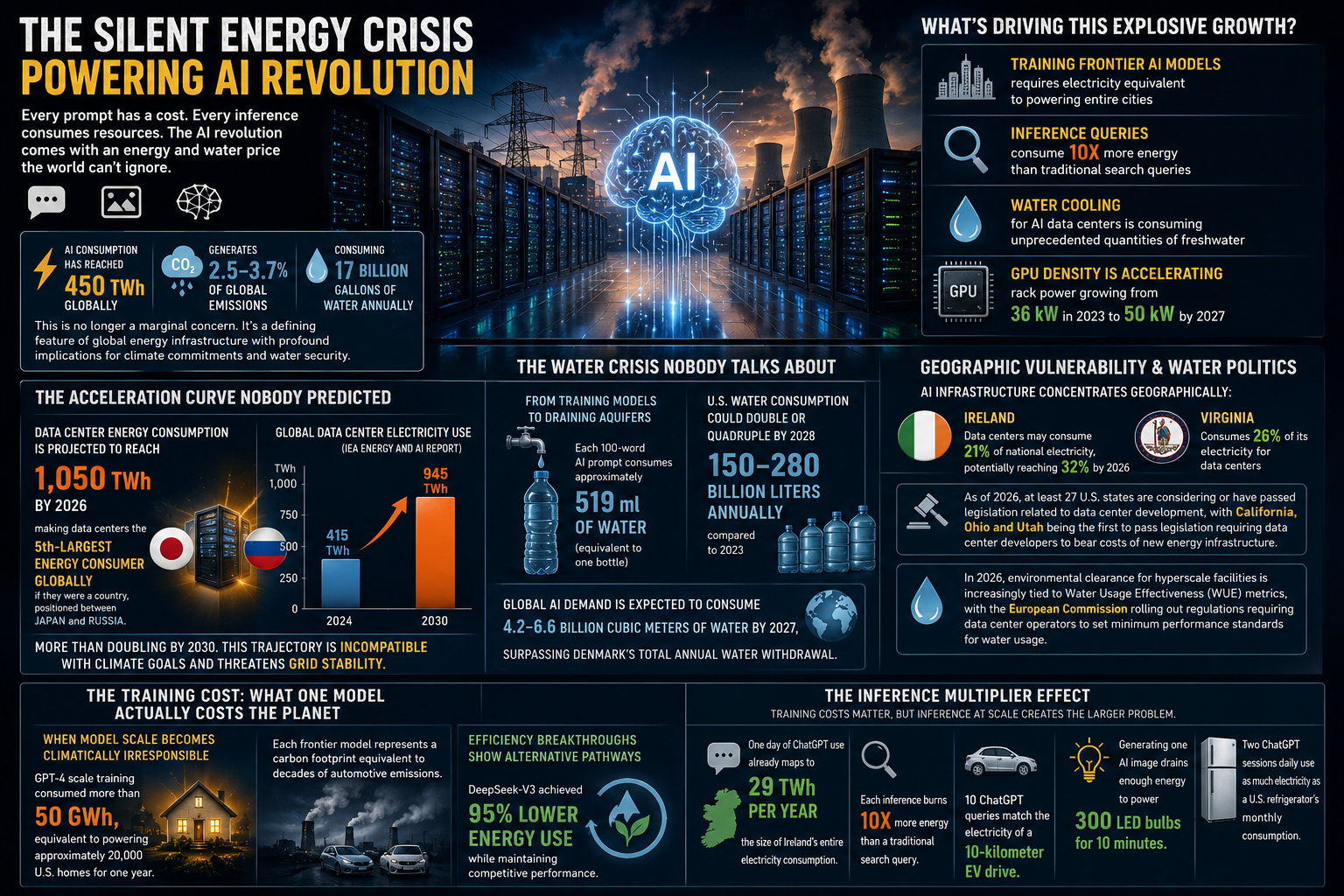
AI consumption has reached 450 TWh globally and generates 2.5-3.7% of global emissions, consuming 17 billion gallons of water annually. This is no longer a marginal concern for tech enthusiasts. It has become a defining feature of global energy infrastructure with profound implications for climate commitments and water security.
What's driving this explosive growth:
- Training frontier AI models requires electricity equivalent to powering entire cities
- Inference queries (everyday AI use) consume 10 times more energy than traditional search queries
- Water cooling for AI data centers is consuming unprecedented quantities of freshwater
- GPU density in data centers is accelerating, with rack power growing from 36 kW in 2023 to 50 kW by 2027
The Acceleration Curve Nobody Predicted
Data center energy consumption is projected to reach 1,050 TWh by 2026, making data centers the fifth-largest energy consumer globally if they were a country, positioned between Japan and Russia. The speed of this transformation caught policymakers, grid operators, and environmental advocates by surprise.
Global data center electricity use is expected to grow from 415 TWh in 2024 to 945 TWh by 2030, more than doubling according to the IEA Energy and AI report. This trajectory is incompatible with climate goals and threatens grid stability across multiple nations.
The Water Crisis Nobody Talks About
From Training Models to Draining Aquifers
While electricity consumption dominates headlines, the water crisis accompanying AI infrastructure represents an equally critical environmental threat. Each 100-word AI prompt consumes approximately 519 milliliters of water, equivalent to one bottle. U.S. water consumption could double or quadruple by 2028 to 150-280 billion liters annually compared to 2023.
Global AI demand is expected to consume 4.2-6.6 billion cubic meters of water by 2027, surpassing Denmark's total annual water withdrawal. The concentrations create crisis points in water-stressed regions where hyperscale data centers cluster.
Geographic Vulnerability & Water Politics
The problem intensifies because AI infrastructure concentrates geographically:
- Ireland faces data center demand consuming around 21% of national electricity, potentially reaching 32% by 2026
- Virginia consumes 26% of its electricity for data centers
- As of 2026, at least 27 U.S. states are considering or have passed legislation related to data center development, with California, Ohio and Utah being the first to pass legislation requiring data center developers to bear costs of new energy infrastructure
In 2026, environmental clearance for hyperscale facilities is increasingly tied to Water Usage Effectiveness (WUE) metrics, with the European Commission rolling out regulations requiring data center operators to set minimum performance standards for water usage.
The Training Cost: What One Model Actually Costs the Planet
When Model Scale Becomes Climatically Irresponsible
The energy cost of training frontier AI models reveals stark inequalities in who bears environmental consequences. GPT-4 scale training consumed more than 50 GWh, equivalent to powering approximately 20,000 U.S. homes for one year. Each frontier model represents a carbon footprint equivalent to decades of automotive emissions.
However, efficiency breakthroughs demonstrate alternative pathways: DeepSeek-V3 achieved 95% lower energy use while maintaining competitive performance, showing that dramatic efficiency gains are possible through architectural innovation.
The Inference Multiplier Effect
Training costs matter, but inference at scale creates the larger problem. One day of ChatGPT use already maps to 29 TWh per year, the size of Ireland's entire electricity consumption. Each inference burns 10 times the energy of a traditional search query, with 10 ChatGPT queries matching the electricity of a 10-kilometer EV drive.
The mathematics are sobering: Generating one AI image drains enough energy to power 300 LED bulbs for 10 minutes, and two ChatGPT sessions daily use as much electricity as a U.S. refrigerator's monthly consumption.