The Race for AI Independence Accelerates
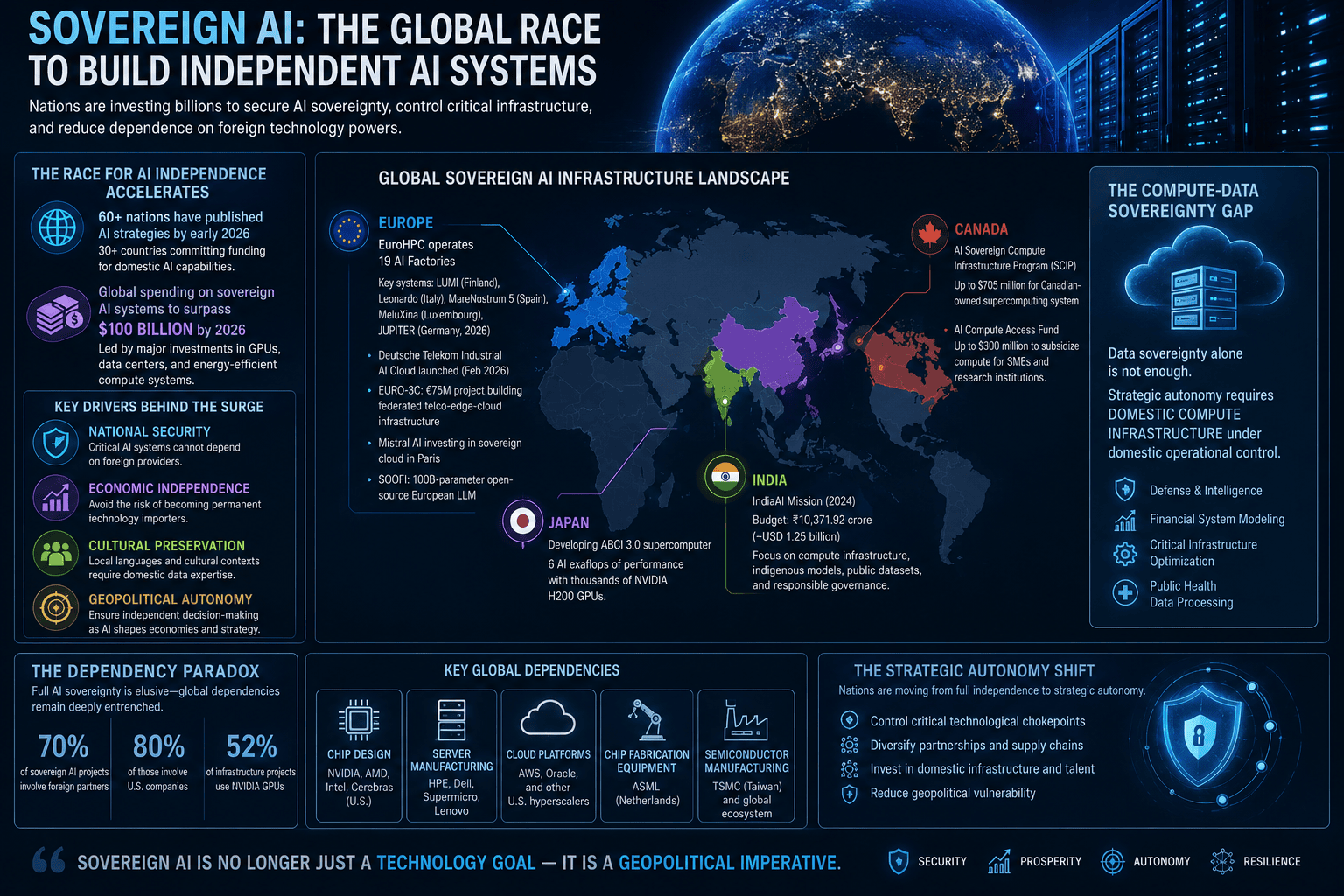
More than 60 nations have published formal AI strategies by early 2026, with over 30 committing specific funding to build domestic AI capabilities, compared to sovereign AI being discussed primarily in policy circles in 2024. This represents a dramatic acceleration from regulatory concept to national infrastructure investment, driven by converging pressures: national security concerns, economic competitiveness fears, and recognition that AI capabilities may become as strategically important as nuclear technology or space capability.
Global spending on sovereign AI systems is projected to surpass $100 billion by 2026, with countries like France leading investments in GPUs, data centers, and energy-efficient compute systems. The scale of capital deployment reveals the strategic seriousness behind sovereign AI initiatives.
What motivates this investment surge:
- National security: AI systems controlling critical infrastructure cannot depend on foreign providers for continuity
- Economic independence: Countries without domestic AI capabilities risk becoming permanent technology importers
- Cultural preservation: Training AI models on local languages and cultural contexts requires domestic data expertise
- Geopolitical autonomy: Ensuring a nation can act independently as AI mediates economic activity and strategic decision-making
The Compute-Data Sovereignty Gap
The critical realization driving 2025-2026 infrastructure spending is that data governance alone proves insufficient for strategic autonomy. Data sovereignty without compute sovereignty proved strategically inadequate, triggering a wave of government investment in domestic AI infrastructure that accelerated through 2025 and into 2026. Defense intelligence analysis, financial system modeling, critical infrastructure optimization, and public health data processing require domestic compute infrastructure under domestic operational control.
Global Sovereign AI Infrastructure Landscape
The European Compute Backbone
Europe is constructing substantial sovereign compute capacity through coordinated regional initiatives. EuroHPC now has 19 operational or selected AI Factories, with flagship systems including LUMI in Finland, Leonardo in Italy, MareNostrum 5 in Spain, MeluXina in Luxembourg, and JUPITER in Germany projected for 2026 as Europe's first exascale-class system.
Key European developments include:
- Deutsche Telekom's Industrial AI Cloud opened in Munich February 2026 with immediate 80 percent feature parity with US hyperscalers
- EURO-3C, a 75 million euro European Commission-backed project announced at MWC 2026 building Europe's first large-scale federated telco-edge-cloud infrastructure
- Mistral AI's sovereign cloud infrastructure with Paris data center investment
- SOOFI, a 100-billion parameter European open-source language model developed by Fraunhofer and DFKI
Regional Competition & Collective Strategy
Europe controls less than 5% of global AI compute while US hyperscalers dominate over 70% of the regional cloud market, forcing enterprises to rethink where AI systems run and under whose laws. This imbalance accelerated Europe's infrastructure spending and regulatory strategy, combining physical infrastructure investment with the EU AI Act entering into force August 2, 2026.
National AI Strategies: Case Studies in Infrastructure Investment
Asia-Pacific Innovation
Japan is building AI sovereignty through ABCI 3.0, developed by the National Institute of Advanced Industrial Science and Technology in collaboration with Hewlett-Packard Enterprise and NVIDIA, designed to deliver 6 AI exaflops of performance with thousands of NVIDIA H200 GPUs, making it one of the most powerful open-access AI supercomputers in the world.
India is strengthening AI sovereignty through the IndiaAI Mission, a comprehensive national initiative approved in 2024 with a budget of 10,371.92 crore (approximately USD 1.25 billion), focusing on building a self-reliant AI ecosystem combining compute infrastructure, indigenous foundational models, public datasets and responsible governance.
North American Approaches
Canada established the AI Sovereign Compute Infrastructure Program (SCIP) with up to 705 million dollars to build a state-of-the-art public supercomputing system fully Canadian-owned and operated, plus an AI Compute Access Fund providing up to 300 million dollars to subsidize compute for small and medium enterprises and research institutions.
The Dependency Paradox: Why Full Sovereignty Remains Elusive
Foreign Technology Embedded Across National Projects
Data from the Sovereign AI Index reveals a critical tension between sovereignty aspiration and infrastructure reality. Roughly 70 percent of tracked national sovereign AI projects involve at least one foreign partner, with four-fifths of these involving a U.S. company, and NVIDIA alone supplies GPUs for 52 percent of all tracked infrastructure projects.
This dependency structure reflects fundamental supply chain realities:
- Advanced chip design dominated by US companies including NVIDIA, AMD, Intel and Cerebras
- Server manufacturing concentrated with HPE, Dell, Supermicro and Lenovo
- Cloud platforms primarily provided by AWS, Oracle and other US-based hyperscalers
- Semiconductor fabrication equipment monopolized by Netherlands-based ASML
The Strategic Autonomy Shift
True 100 percent national AI sovereignty is a practical impossibility because no single nation, including the US or China, controls all seven links of the complex AI supply chain, which spans raw materials, chip fabrication, and skilled talent.
The realistic framework emerging across nations prioritizes strategic autonomy rather than complete independence, controlling critical chokepoints while managing unavoidable global dependencies through diversified partnerships and regulatory frameworks.