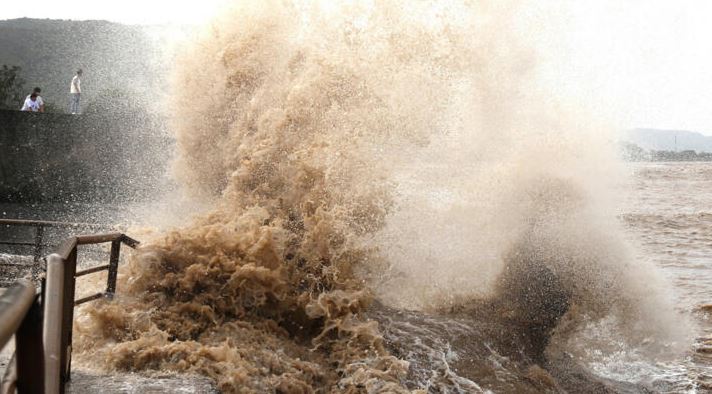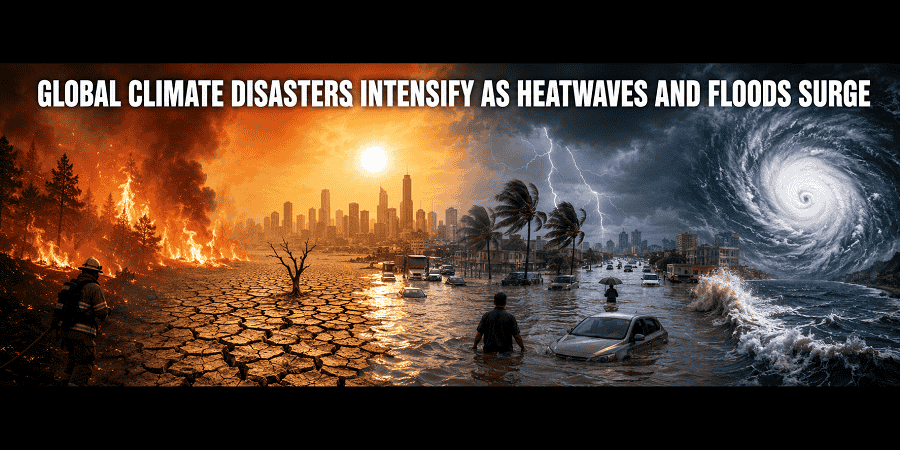
The numbers no longer leave room for debate. In 2025, heatwaves, wildfires, drought, tropical cyclones, storms, and flooding caused thousands of deaths, impacted millions of people, and caused billions in economic losses, according to the World Meteorological Organization. What the data now reveals, across multiple authoritative datasets, is a system under cascading stress: disasters are not just growing more intense but arriving faster, hitting harder, and costing more than any previous decade on record.
The Numbers Behind the Crisis
From 1995 to 2024, more than 832,000 lives were lost and direct economic losses of nearly USD 4.5 trillion were recorded, driven by more than 9,700 extreme weather events. That figure, adjusted for inflation, represents the accumulated cost of a crisis that governments spent decades treating as a future problem.
The acceleration is what separates today's data from historical averages. In the United States alone, the number of severe climate disasters increased nearly five-fold in 2024 compared to the 1990-2000 decade. The average time between severe disasters is now just 12 days, compared to an average of 82 days in the early 1980s.
Key figures from the Climate Risk Index 2026:
- Storms accounted for 77% of total economic losses in 2024, equivalent to USD 172.61 billion
- Floods caused an additional USD 32.77 billion in economic damage, representing 15% of total losses
- The WMO recorded 151 unprecedented extreme weather events in 2024, meaning each was worse than any previously recorded in that region
- More than 800,000 people were displaced and made homeless in 2024, the highest yearly number since records began in 2008
Heat as a Systemic Threat
Heatwaves sit at the intersection of every other climate risk. They weaken infrastructure, reduce agricultural yields, and amplify the conditions that drive wildfires and intensified storms. The WMO's 2025 report links climate directly to growing health challenges, with 1.2 billion workers exposed to heat stress annually and about half the world's population now at risk of dengue fever.
In 2025, intense heatwaves pushed temperatures above 40 degrees Celsius across large parts of Latin America, including a record-breaking 52.7 degrees Celsius in Mexico. Europe recorded over 60,000 heat-related deaths in a single summer heatwave season. Despite La Nina conditions in 2025, around 90% of the ocean surface area experienced at least one marine heatwave, a figure that would have seemed implausible just fifteen years ago.
Floods Reshape Communities and Economies
Flooding is now the climate crisis's most visible displacement machine. Flooding affected at least 650,000 people in Southern Africa alone, displaced hundreds of thousands, and destroyed or damaged at least 30,000 homes, according to Mozambique's National Disasters Management Institute.
The economic architecture of disaster is shifting alongside the human cost:
- The top 10 costliest climate disasters of 2025 included wildfires, cyclones, extreme rainfall, flooding, and droughts spanning four continents, together resulting in economic losses of USD 120 billion
- Flooding affected more than 110,000 people in Peru and Ecuador, while floods in Mexico killed 83 people and caused widespread infrastructure damage and landslides
- Floods in the Congo displaced 350,000 people, and the deluge at Rio Grande do Sul displaced over half a million people
- Several French regions experienced exceptional flooding in early 2026 following Storm Nils, placing the entire western half of France under a severe rain and flood warning
The Vulnerability Gap
The data consistently shows that climate risk is not distributed equally. Of the 10 most affected countries in 2024, seven are in the low-income and lower-middle income bracket, despite contributing the least to global emissions. Vulnerability is shaped less by emissions and more by resilience. Many of the most affected countries rely heavily on climate-sensitive sectors such as agriculture, lack robust infrastructure, and have limited fiscal space for recovery. A single extreme event can erase years of development gains.
Hurricane Melissa became the first Category 5 hurricane on record to make landfall in Jamaica in October 2025, killing 45 people and causing economic losses equal to more than 41 percent of the country's GDP.
What the Data Demands Now
The WMO Secretary-General stated plainly: the planet is being pushed beyond its limits. The State of the Global Climate is in a state of emergency.
The scientific consensus has moved beyond projections. The narrowing window to stay within the 1.5 degrees Celsius warming threshold means that every fraction of a degree of additional warming raises the odds of passing irreversible tipping points.
While coverage of early warning systems has more than doubled since 2015, around 40 percent of countries still lack full coverage, leaving millions exposed to preventable risks from extreme weather such as heatwaves, floods, storms, droughts and wildfires.
The policy gap between what the data shows and what governments are doing remains the defining crisis within the crisis. Every delayed decision is now measurable: in displaced communities, in lost GDP, and in the shrinking interval between one disaster and the next.