Who Is Weaponizing Deepfakes and Why It Matters Right Now
The World Economic Forum's Global Risks Report 2026 placed misinformation and disinformation among the top short-term global risks, alongside geoeconomic confrontation and societal polarization. It is one of the few risks that remains severe over both the two-year and ten-year horizons and is seemingly the risk that catalyzes or worsens all other risks on the list.
This is not a theoretical warning. It is an active crisis unfolding in real time across every major geopolitical flashpoint.
In 2026, AI-generated content has surged across social media in both volume and visibility. Fake drone footage, fabricated satellite images, edited clips, and synthetic statements are spreading widely, often reaching millions of viewers. The fog of war has been turbocharged by machine-generated media engineered specifically to distort public perception.
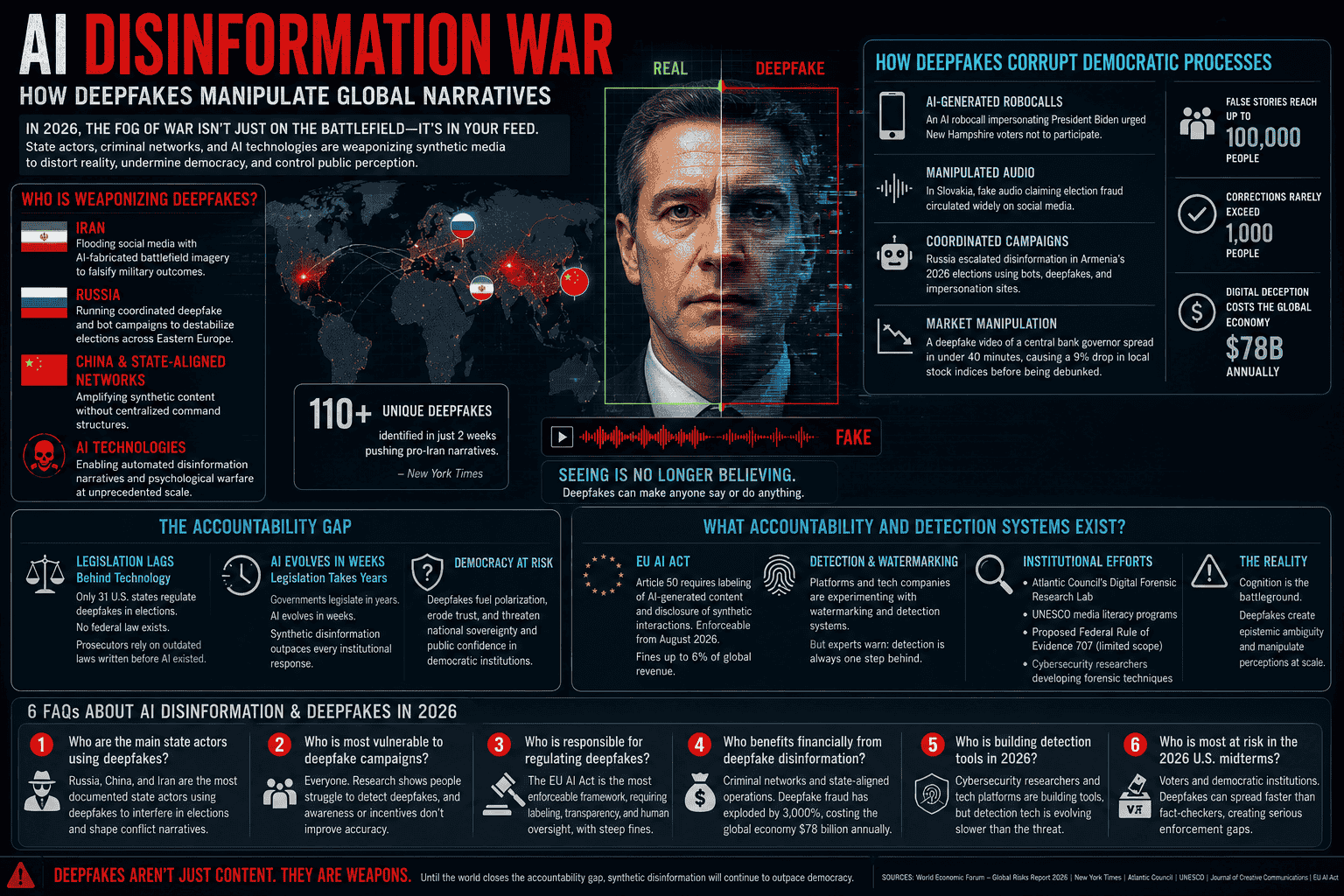
The actors driving this disinformation war are not anonymous trolls. They are state-sponsored networks, authoritarian governments, and geopolitical rivals operating with military-level precision. Key players include:
- Iran, actively flooding social media with AI-fabricated battlefield imagery to falsify military outcomes
- Russia, running coordinated deepfake and bot campaigns to destabilize elections across Eastern Europe
- State-aligned networks amplifying synthetic content without centralized command structures
- AI technologies enabling automated disinformation narratives and psychological warfare operations targeting both domestic and international audiences at unprecedented scale
The New York Times identified more than 110 unique deepfakes within a two-week period conveying a pro-Iran message through battlefield images, missile strike depictions, and fabricated war footage. Much like the deepfake surge during the June 2025 Iran conflict, when Iranian accounts spread fake videos of prominent Israeli landmarks ablaze and repurposed battle footage from other conflicts, the purpose of this content is to push a false narrative of Iranian military success and Western failure.
How Deepfakes Are Engineered to Corrupt Democratic Processes
Advanced AI-generated content can now create highly convincing videos of political figures saying things they have never said or doing things they have never done. The timing of such releases, especially during election cycles, can change public opinion before the deepfake can be discredited.
This is not hypothetical. The documented evidence of electoral manipulation through synthetic media is already substantial.
- In the United States, an AI-generated robocall impersonating President Joe Biden urged New Hampshire Democratic primary voters not to participate, demonstrating how artificial intelligence can directly undermine voter turnout.
- In Slovakia's parliamentary elections, manipulated audio deepfakes falsely claiming election fraud circulated widely on social media.
- Russia escalated a coordinated foreign information manipulation campaign in Armenia ahead of the 2026 elections, using bots, deepfakes, and impersonation sites to portray the government as corrupt or foreign-controlled.
- A deepfake video of a central bank governor announcing capital controls spread in under 40 minutes, triggering a temporary 9 percent drop in local stock indices before being debunked.
The scale of the problem is compounded by a critical vulnerability in human cognition. A study published in the Journal of Creative Communications demonstrated that people struggle to identify deepfake videos and that their opinions are influenced by this type of disinformation. A pre-registered experiment confirmed the finding: people do not reliably detect deepfakes, and neither risk awareness nor financial incentives improve accuracy.
False AI-generated stories reach up to 100,000 people while corrections rarely exceed 1,000. Digital deception now costs the global economy $78 billion annually.
The legislative framework governing this threat is critically underpowered:
- Only 31 U.S. states have laws regulating deepfakes in elections, and at the federal level, no legislation exists that prohibits the use of deepfakes in political campaigns.
- Prosecutors must apply a patchwork of older laws involving fraud, election interference, identity theft, and defamation, frameworks written before generative AI existed.
- State-sponsored actors like Russia and China increasingly use deepfakes to interfere in foreign elections, threatening national sovereignty and public confidence in democratic institutions, while domestic and international frameworks offer only partial protection.
What Accountability and Detection Systems Actually Exist
The EU AI Act reflects a meaningful regulatory shift. Article 50 requires labeling of AI-generated and deepfake content and disclosure of synthetic interactions, enforceable from August 2026 with fines up to 6 percent of global revenue.
That is the most consequential regulatory mechanism currently in existence. Everything else is fragmented, voluntary, or outpaced by the technology itself.
Major social media platforms have begun experimenting with digital watermarking and detection systems designed to identify AI-generated media. However, experts warn that technology is evolving so quickly that detection systems may always remain one step behind.
Google's SynthID now tags generated media, yet adversaries simply migrate to unmarked open-source models, undermining the effectiveness of watermarking as a containment strategy.
The institutional response remains uncoordinated and reactive. What accountability infrastructure does exist includes:
- The Atlantic Council's Digital Forensic Research Lab, tracking state-sponsored disinformation campaigns and synthetic media operations globally
- UNESCO-backed media literacy programs building public capacity to critically evaluate digital content
- A proposed Federal Rule of Evidence 707, which attempts to regulate the admissibility of AI-generated evidence in courts, requiring such evidence to meet reliability standards, though it applies only to evidence the proponent acknowledges as AI-generated and does not address undisclosed deepfakes
- Cybersecurity researchers exploring forensic techniques capable of identifying subtle artifacts left by AI generation systems
Cognition itself is now part of the battleground. Deepfakes are used as weapons to mold perceptions, obscure facts, and produce epistemic ambiguity. Even more advanced generative AI disinformation is likely to be used in future conflicts, which could seriously jeopardize escalation management and public trust.
The accountability gap is structural. Governments legislate in years. AI evolves in weeks. Until that asymmetry is closed, synthetic disinformation will continue to outpace every institutional response designed to contain it.