The AI economy is no longer a forecast. It is showing up in hiring data, layoff announcements, and corporate earnings calls right now, in 2026. But the picture is messier than the "robots will take your job" headlines suggest. Some sectors are shedding workers fast. Others are hiring aggressively and paying premiums for AI skills. Understanding which side of that line your industry sits on matters more than ever.
How AI Is Reshaping the Job Market in 2026
The Scale of Exposure
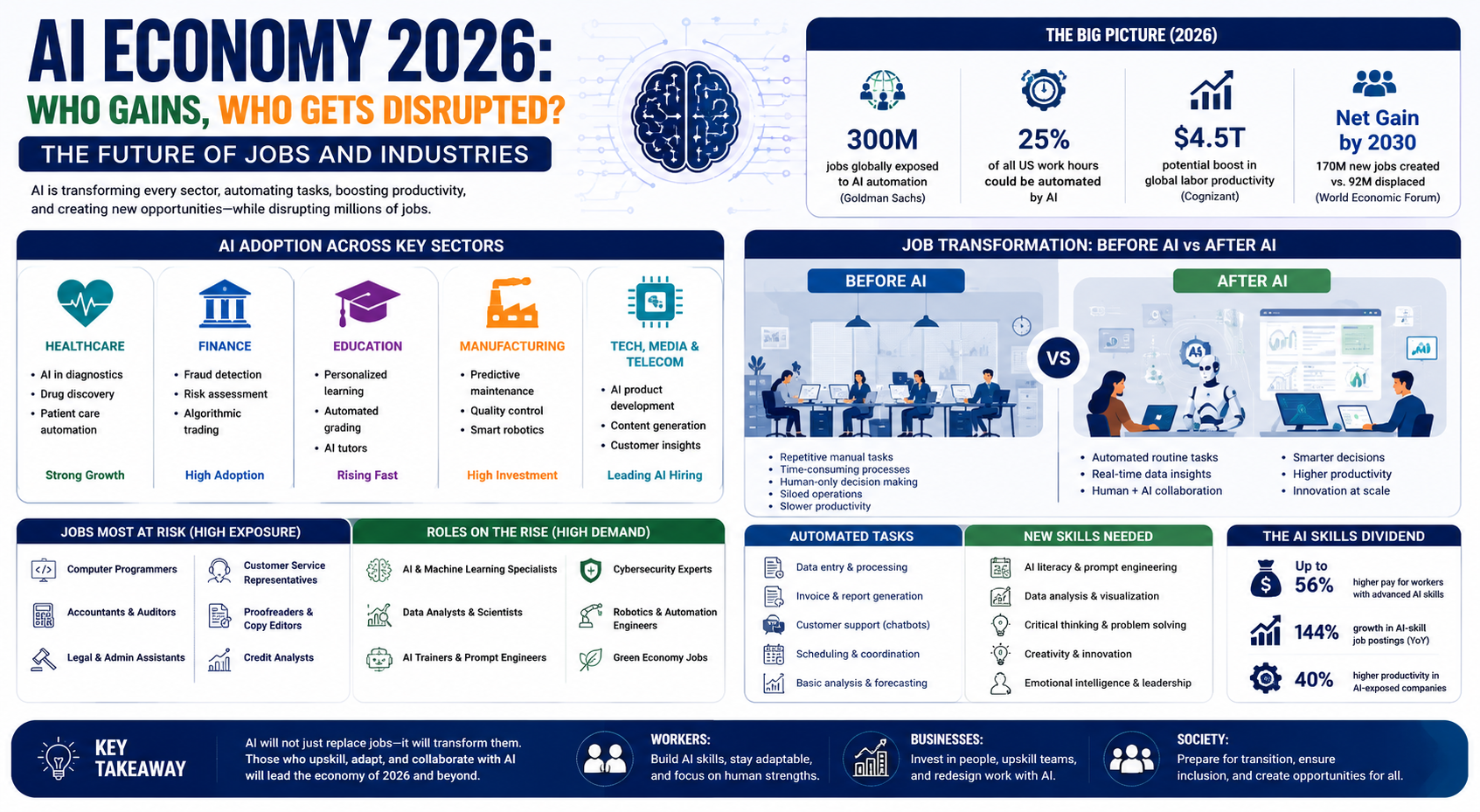
Goldman Sachs estimates that around 300 million jobs globally are exposed to AI automation, with AI capable of automating tasks that account for 25 percent of all US work hours. Separately, Cognizant's research suggests roughly 93 percent of US jobs can be partially performed by AI in some capacity, with the potential to unlock over 4.5 trillion dollars in labor productivity.
Despite those large exposure numbers, actual job losses remain concentrated rather than economy-wide. Goldman Sachs found no significant statistical correlation between AI exposure and broader labor measures like job growth, unemployment, or wage growth so far. If current AI use cases expanded across the whole economy, only about 2.5 percent of US employment would be at risk of displacement, based on their modeling.
Where Disruption Is Already Visible
Employment growth has slowed below trend in marketing consulting, graphic design, office administration, and telephone call centers, with companies citing AI-driven efficiency gains. Tech-sector hiring has also cooled sharply in computer systems design, software publishing, and web search, with tech's overall employment share steadily shrinking since late 2022.
Occupations facing the highest disruption risk include:
- Computer programmers.
- Accountants and auditors.
- Legal and administrative assistants.
- Customer service representatives and telemarketers.
- Proofreaders and copy editors.
- Credit analysts.
Block, the payments company behind Square and Cash App, cut its workforce from roughly 10,000 to 6,000 employees, a 50 percent reduction explicitly tied to AI automating fraud detection, risk assessment, and customer support.
Who Is Gaining From the AI Economy
Infrastructure and Skilled Trades
Not every disrupted job disappears into thin air. As knowledge workers face displacement, demand is rising for skilled technical roles like construction workers, engineers, electricians, and lineworkers, with roughly 500,000 net new US jobs needed by 2030 just to meet growing power demand.
AI capital spending, estimated at 660 billion dollars in the US, is driving demand for steel, copper, concrete, and construction labor tied to data center buildouts, which helps offset tech-sector job losses in the broader economic data.
The Wage Premium for AI Skills
This is where the real divide shows up.
- Workers with advanced AI skills earn wage premiums up to 56 percent higher than peers without them.
- Productivity growth has nearly quadrupled since 2022 in industries most exposed to AI.
- US job postings requiring AI skills grew 144 percent year over year as of April 2026.
- Companies most exposed to AI are seeing productivity growth 40 percent higher than those least exposed, and they are raising both wages and headcount faster.
Sector Snapshot
The technology, media, and telecoms sector leads all industries in AI hiring intensity, with nearly one in eight new roles now AI related. Manufacturing is investing heavily too, showing a higher share of job ads requiring AI skills than even financial services. Beyond tech, strong growth is also expected in healthcare, education, and green economy jobs.
The Net Jobs Question: Creation Versus Destruction
The most cited long-term projection comes from the World Economic Forum. It projects that by 2030, job disruption will touch 22 percent of all roles, with 170 million new jobs created and 92 million displaced, a net gain of 78 million positions globally.
That net positive figure hides real pain at the individual level.
- Stanford data shows a 13 percent decline in entry-level hiring for AI-exposed roles since generative AI adoption accelerated.
- A 2026 Federal Reserve Bank of New York study found recent college graduates aged 22 to 27 facing 5.6 percent unemployment, well above the 4.2 percent national rate.
- Entry-level workers in their 20s and 30s entering knowledge and content creation roles are likely to be hit hardest by new AI deployments.
Economists caution against reading every layoff as AI-driven. Many tech sector corrections that began in 2022 were financially motivated, even though AI is now accelerating cuts in coding-related roles specifically.
What This Means for Workers and Businesses
For workers, the practical priorities are:
- Build hands-on AI fluency rather than passive familiarity.
- Strengthen judgment-based skills like leadership, critical thinking, and strategy.
- Watch for roles where AI augments rather than replaces human work.
- Treat AI skills as a wage differentiator, not just a resume line.
For businesses, the warning signs are different:
- Companies risk losing an estimated 5.5 trillion dollars by 2026 due to unaddressed skills gaps.
- Only 6 percent of leaders report real progress in redesigning how humans and AI work together, according to Deloitte's 2026 Global Human Capital Trends report.
- Organizational culture and governance matter more than individual tool adoption in determining whether AI investment actually pays off.