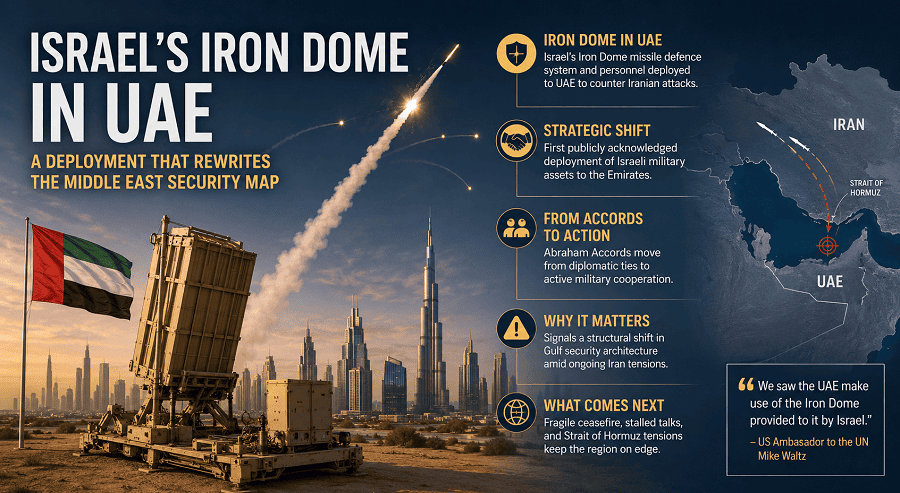
US Ambassador to the United Nations Mike Waltz became the first government official to publicly confirm that Israel's Iron Dome missile defence system had been used to shoot down Iranian missiles targeting the United Arab Emirates, stating at an event hosted by the Israeli Mission to the UN in New York: "We saw the UAE make use of the Iron Dome provided to it by Israel."
The deployment, which includes Iron Dome batteries and personnel trained to operate them, was sent to the UAE to help defend against Iranian attacks during a war that began on February 28 with US and Israeli strikes on Iran. It represents the first publicly acknowledged deployment of Israeli military assets to the Emirates, a federation of seven sheikhdoms on the Arabian Peninsula home to Abu Dhabi and Dubai.
This is not a symbolic gesture. It is a structural shift in the Gulf's security architecture, one whose consequences will reverberate long after any ceasefire holds.
The Strategic Logic Behind the Deployment
Iran has targeted the UAE more than any other country during the current conflict, and has continued launching attacks even during the present truce. Tensions remain elevated, with the Strait of Hormuz still under Tehran's strategic control and US-Iran negotiations reportedly stalled, raising serious concerns about a return to open conflict.
US Ambassador to Israel Mike Huckabee framed the deployment in stark ideological terms at the Tel Aviv Conference, telling Gulf states they must choose a side, asking whether they believe they are more likely to be attacked by Iran or Israel and arguing that Israel is not trying to take over their land or sending missiles at them.
A senior Emirati official, Anwar Gargash, adviser to the UAE president, said in March that Iranian attacks on Arab neighbours would only strengthen relations between Israel and those Arab states that hold diplomatic ties with Israel. That observation has now been proven correct in hardware terms.
Abraham Accords to Active Defence Pact
The UAE diplomatically recognised Israel in 2020 under the Abraham Accords, a move that drew immediate and sustained criticism from Tehran, which had long warned that normalisation with Israel would compromise Gulf security. The deployment of Iron Dome batteries confirms that normalisation has now evolved into active military cooperation.
Huckabee praised the UAE as the first Abraham Accord member, describing the relationship as one built on shared threat perception toward Iran. Despite coming under sustained Iranian missile attacks, several Gulf states have not responded militarily or moved closer to Israel publicly, reflecting the delicate domestic and regional calculations each government must manage.
Iran did not immediately respond to Huckabee's remarks, though it has repeatedly claimed for years that Israel maintained a military and intelligence presence in the Emirates. Those claims, once dismissed as propaganda, now carry a different weight.
What Comes Next: Ceasefire, Escalation, or Realignment
President Donald Trump said Monday that the ceasefire with Iran was "on life support", a characterization that places the entire regional security framework under immediate pressure. The narrow Strait of Hormuz remains under Tehran's chokehold, and negotiations between Washington and Tehran appear to be at a standstill, raising the risk of conflict resuming.
Trump and UAE President Mohammed bin Zayed Al Nahyan held a phone call on Tuesday to discuss strategic cooperation and ways to strengthen bilateral relations in support of mutual interests, with both sides also exchanging views on the latest developments in the Middle East.
The Iron Dome deployment is the clearest signal yet that the Gulf's security architecture is no longer being negotiated quietly through back channels. It is being built in plain sight, battery by battery, under the shadow of Iranian missiles.