How a Supreme Court Judge's Remark Sparked India's Most Talked-About Political Movement of 2026
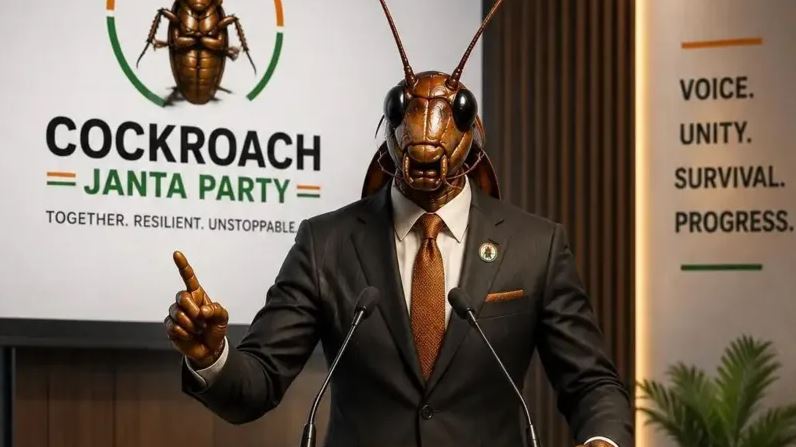
The Cockroach Janta Party, or CJP, is an Indian satirical political movement founded on May 16, 2026, by Abhijeet Dipke, a former social media strategist for the Aam Aadmi Party. The party emerged as a direct response to remarks made by Chief Justice of India Surya Kant on May 15, 2026, in which he compared unemployed youth to "cockroaches" and "parasites of society."
During a Supreme Court hearing on a case involving fake professional credentials, Chief Justice Surya Kant said: "There are already parasites of society who attack the system. There are youngsters like cockroaches; they don't get any employment, they don't have any place in profession. Some of them become media, some of them become social media, RTI activists and other activists, and they start attacking everyone."
The remark landed like a lit match in a room full of dry leaves. Within 72 hours, a satirical party was born, a lakh Indians had signed up, and the Chief Justice himself was forced to issue a public clarification.
The Spark: What the Chief Justice Actually Said, and What Followed
Following the backlash, Chief Justice Surya Kant issued a clarification on May 16, stating that his remarks had been misquoted. He said he was specifically criticising individuals who had entered the legal profession using fake and bogus degrees, not the country's unemployed youth. "Not only am I proud of our present and future human resource, but every youth of India inspires me. I see them as the pillars of a developed India," he said.
The clarification did little to cool the online temperature. For millions of young Indians already dealing with exam paper leaks, shrinking job markets, and a political system that rarely speaks their language, the words had already struck a nerve.

Who Is Behind the CJP and What Does It Actually Stand For
The Founder: Abhijeet Dipke
The 30-year-old, a recent graduate in public relations from Boston University in the United States, finds himself leading a sweeping satirical political movement being joined online by thousands of people with each passing day.
It is worth noting that from 2020 to 2022, Dipke was employed by the Aam Aadmi Party's social media staff, where he contributed to meme-driven campaign material during the Delhi Assembly elections. That experience is clearly visible in the Cockroach Janta Party's approach and tone.
The Movement's Identity and Reach
The CJP's growth has been nothing short of remarkable for any political formation, satirical or otherwise:
- The party claims over one lakh members joined within three days, alongside 38,000 followers on X and 4,20,000 on Instagram.
- By May 18, the platform had crossed 40,000 sign-ups, with Trinamool Congress MPs interacting with the movement online.
- Notable figures including TMC's Mahua Moitra and Kirti Azad have been "admitted" as members of the CJP.
- The movement has since spread to several states, including Bihar, Madhya Pradesh, Uttar Pradesh, and Himachal Pradesh.
What the CJP Calls Itself
The movement portrays itself as a voice for frustrated young Indians who are struggling with unemployment, exam scandals, precarious work, cyberbullying, and a growing feeling of alienation from institutions. The movement welcomed the term "cockroach" rather than condemning it. Its message is straightforward: if surviving challenging systems turns people into "cockroaches," then perhaps resilience has evolved into a form of protest in and of itself. The party calls itself "Secular, Socialist, Democratic, and Lazy."
The CJP slogan is "Main Bhi Cockroach," meaning "I am also a cockroach," reclaiming the insult as a symbol of solidarity.
From Memes to Mobilisation: Can Satire Translate Into Real Politics
The Bihar Question
Reports indicate that supporters of the Cockroach Janta Party are considering contesting the upcoming Bankipur Assembly by-election in Bihar. That is a significant escalation from an online joke to ground-level electoral politics, and it signals that at least some members are serious about converting digital frustration into organised action.
The Broader Issues the CJP Reflects
The movement has gained traction because it speaks to real, documented grievances:
- Widespread youth unemployment and underemployment across urban and semi-urban India
- Recurring competitive examination paper leaks that have derailed millions of aspirants
- Perception that established political parties offer performative sympathy but no structural solutions
- A growing digital-native generation that is politically aware but institutionally excluded
Dipke's Own Assessment
Dipke has acknowledged that the movement may die out quickly, stating: "I am not delusional; I know this can die out in a few days. I do want to make it an independent body, but the least I can do is create a space or platform for people, especially the youth, to be heard."
That kind of self-awareness is itself unusual in Indian political discourse, which rarely rewards honesty about limitations. Whether the CJP registers formally, fields a candidate in Bihar, or fades into a viral footnote, it has already done something meaningful: it made a generation that was called worthless feel seen.