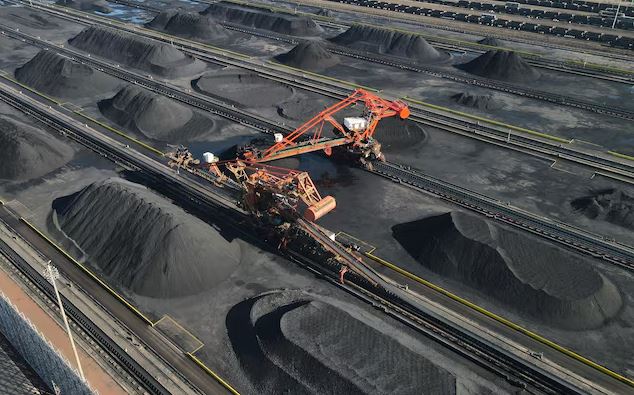
China holds two contradictory titles right now: the world's largest builder of renewable energy and the world's largest consumer of coal. Understanding how both are true at the same time is essential for anyone tracking global commodity markets, carbon policy, or supply chain risk.
The Numbers Behind the Contradiction
China's total power consumption exceeded 10.4 trillion kWh in 2025, more than twice that of the United States. That scale of demand simply cannot be met by renewables alone, not yet.
China added more than 300 gigawatts of solar and 100 GW of wind in 2025, both records for any country ever. Power generation from solar and wind increased by 450 TWh in the first 11 months of the year.
Yet even that pace of clean energy growth barely keeps up with rising electricity demand. The result: coal is not retreating. It is being reinforced.
Key supply-side facts:
- Coal production hit a record 4.85 billion tonnes in 2025.
- 21 GW of new coal capacity was commissioned in H1 2025, the highest first-half total since 2016.
- China added another 24 GW of coal power in Q1 2026 alone.
- Only 1 GW of coal capacity was retired in H1 2025, against a Five-Year Plan target requiring 30 GW total retirements by end of 2025.
The Energy Security Argument Driving Coal Policy
Beijing's push for coal is not irrational from a national security standpoint. China produces more than 90% of the coal it consumes domestically, while imports account for roughly three-quarters of its oil supply and about 40% of its natural gas consumption.
China's crude oil imports fell about 20% year-over-year in April 2026, while natural gas imports declined 12.5%, driven by disruptions linked to tensions over the Strait of Hormuz. Coal, in that context, looks like stability.
Coal currently provides around 70% of peak capacity and nearly 80% of load regulation capacity in China, making the existing coal fleet the most immediate tool for managing variability in wind and solar output.
What is pushing demand higher:
- Rapid AI infrastructure and data center expansion.
- Industrial electrification across manufacturing.
- Long-distance transmission gaps between western renewable hubs and eastern demand centers.
The Policy Tension That Markets Need to Watch
China pledged in 2022 that coal should play a flexible, supporting role while renewables are integrated. That policy has yet to be implemented in any meaningful way.
The rush of new coal project activity signals possible industry pressure to expand before China's 2030 carbon peaking deadline, right when a strategic phase-down should be the priority.
Many newly built coal plants operate under medium and long-term power contracts that guarantee a specific level of utilization, creating direct competition with renewable energy for a limited pool of electricity demand. That structural lock-in is the real long-term risk.