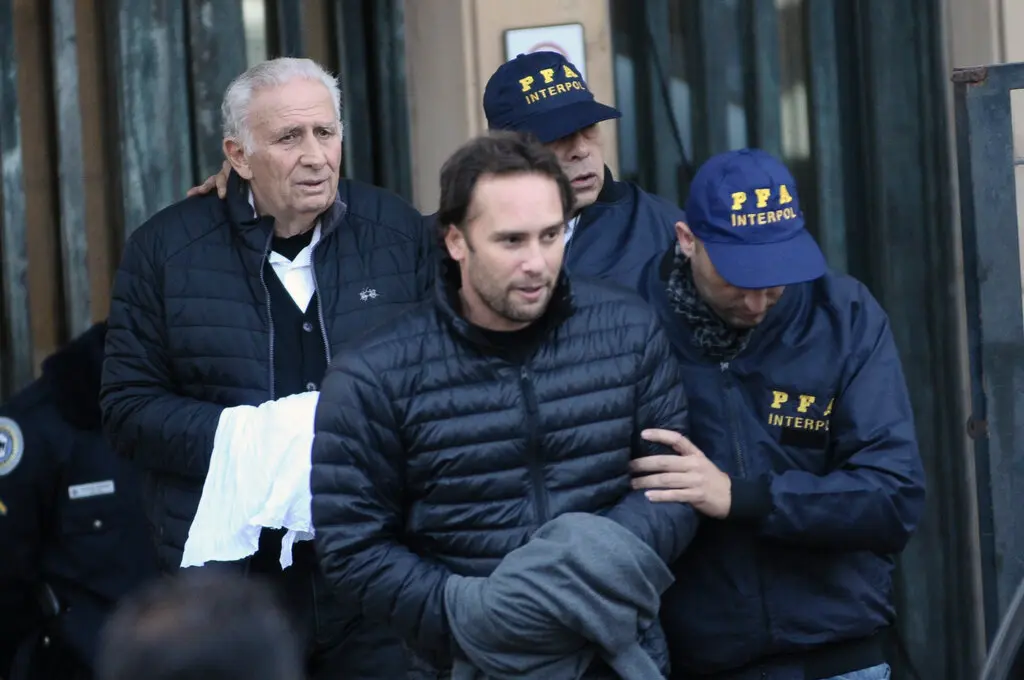
More than a decade after they were first named in the FIFA 2015 scandal, one of sport's largest corruption cases, an Argentine father and son have finally agreed to admit what US prosecutors accused them of all along. Hugo Jinkis and Mariano Jinkis, the controlling principals of Argentine sports marketing company Full Play Group, have reached a deal with federal prosecutors in New York that will see them acknowledge paying millions of dollars in bribes, without spending a day behind bars.
The agreement closes out one of the last major threads of the FIFA 2015 scandal, the sprawling investigation that exposed how football officials across the Americas took payments in exchange for lucrative broadcast and marketing rights. It also raises a familiar question in cases involving wealthy, well-connected defendants: what does accountability look like when the people who ran the scheme avoid prison entirely.
How Hugo Jinkis and Mariano Jinkis Ended Up in a New York Courtroom
The Jinkis family built Full Play Group into one of South America's dominant sports media rights companies, holding broadcasting deals for national teams across the region and, at times, for CONCACAF nations as well. That business model depended on maintaining close relationships with the officials who controlled those rights, relationships prosecutors say were built on cash.
The Original 2015 Indictment
Hugo and Mariano Jinkis were named in the first wave of indictments unsealed on May 27, 2015, the day US authorities dramatically arrested a group of FIFA-linked officials at a luxury hotel in Zurich. The FIFA corruption scandal that followed implicated dozens of federation presidents, marketing executives, and broadcasters across multiple continents.
Prosecutors accused the father and son of the following:
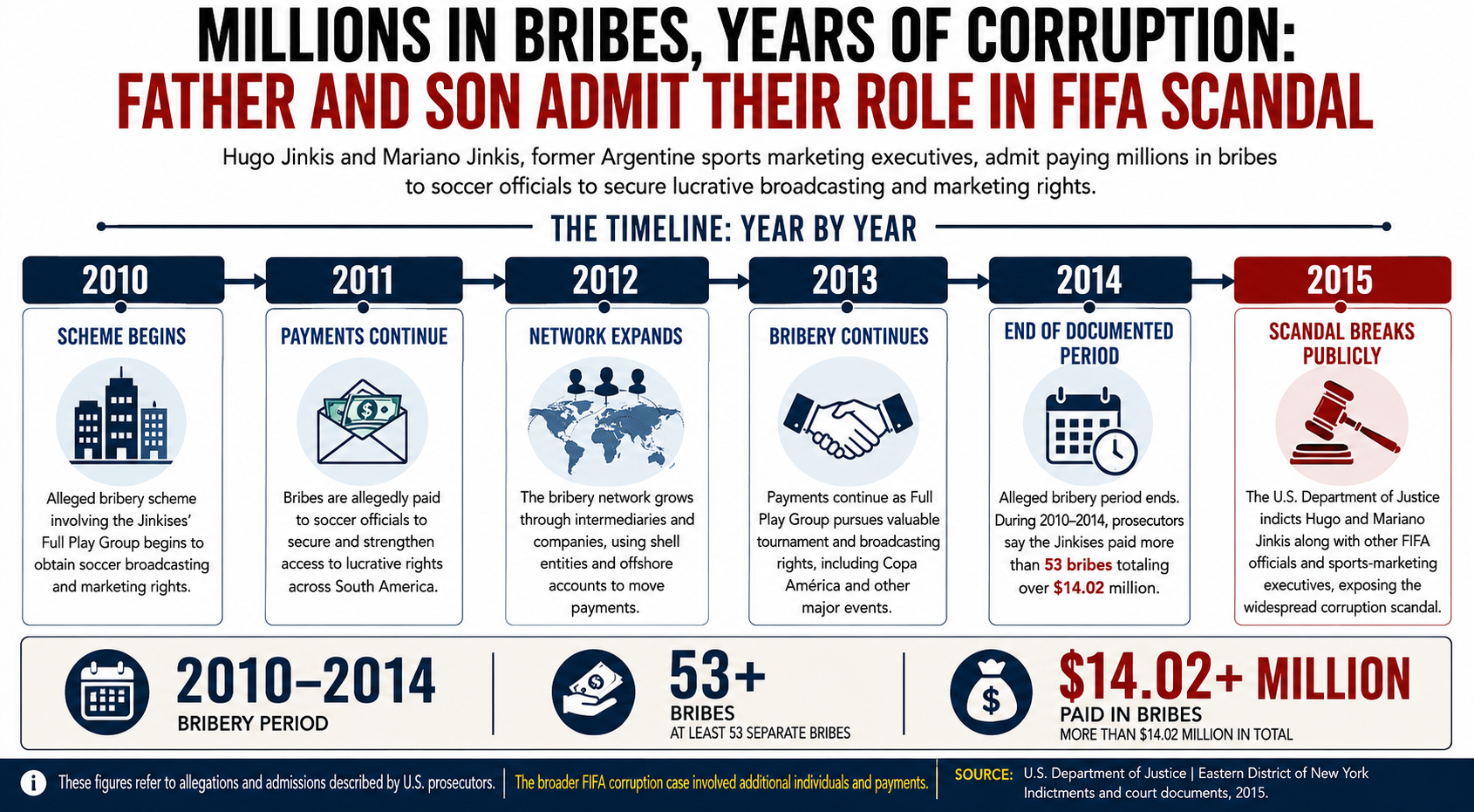
Paying at least 53 bribes worth more than $14 million between 2010 and 2014 to officials at CONMEBOL, South America's football confederation.
Funneling the payments through shell accounts held under the names Cross Trading and Yorkfields to disguise their origin.
Securing marketing rights to the Copa America tournaments in 2015, 2016, 2019, and 2023 through those payments.
Facing charges of racketeering conspiracy, wire fraud conspiracy, and money laundering conspiracy, each carrying the possibility of decades in prison.
Date | Event |
|---|---|
1998 | Full Play Group founded in Argentina by Hugo Jinkis |
2010 to 2014 | Full Play Group pays at least 53 bribes worth more than $14 million to CONMEBOL officials |
2015 to 2023 | Full Play Group secures Copa America marketing rights across four editions of the tournament tied to the bribery scheme |
May 27, 2015 | US authorities arrest FIFA-linked officials in Zurich; first indictments unsealed naming Hugo Jinkis and Mariano Jinkis |
2015 | Hugo and Mariano Jinkis turn themselves in to Argentine police; Argentina blocks their extradition to the US |
August 2015 | Full Play Group's directors resign en masse; new leadership takes over the company |
2015 to 2025 | Hugo and Mariano Jinkis remain in Buenos Aires under court-ordered restrictions, required to stay within 60 kilometers of the court |
Early 2026 | Jinkises travel to New York to open plea negotiations with federal prosecutors |
August 24, 2026 | US government asks a Brooklyn judge to schedule a hearing for the deferred prosecution agreement |
August 26, 2026 | News breaks that Hugo and Mariano Jinkis have agreed to admit paying millions in bribes under a deferred prosecution deal |
A Decade as Fugitives
Unlike several co-defendants who were extradited or voluntarily surrendered to US custody, Hugo and Mariano Jinkis turned themselves in to Argentine police in 2015 but were never handed over to American authorities. Argentina blocked their extradition, and the two men spent roughly a decade living under court-ordered restrictions in Buenos Aires, required to stay within 60 kilometers of the court and to notify judicial authorities before any absence longer than 24 hours.
That standoff appeared to be permanent until earlier this year, when the Jinkises traveled to New York to open negotiations with federal prosecutors, a move reported to have been contingent on assurances they would not face jail time.
What the Deferred Prosecution Agreement Actually Means
According to reporting on the agreement, Hugo and Mariano Jinkis will admit to paying millions of dollars in bribes as part of a deferred prosecution arrangement. Under this kind of deal, prosecutors agree to drop the charges once certain conditions, typically financial penalties, compliance measures, and continued cooperation, are met over a set period.
The arrangement carries real significance beyond one company's legal exposure.
It allows the US Department of Justice to formally close out one of the highest-profile unresolved threads of the FIFA 2015 scandal, more than ten years after the initial arrests.
It avoids a costly, uncertain trial for a case built substantially on aging evidence and cooperating witnesses whose memories and availability have grown less reliable with time.
It reflects a broader pattern in FIFAgate prosecutions, where several defendants who admitted wrongdoing or cooperated with investigators ultimately avoided significant prison time, even as the case exposed billions of dollars in corrupt payments across international football.
Federal prosecutors have also asked a Brooklyn judge to schedule a hearing so the agreement can be formally entered into the court record, a procedural step expected to finalize the terms publicly.
Why the Outcome Still Matters for Football's Accountability Problem
Full Play Group's bribery scheme was not a minor or isolated arrangement. Court records describe a systematic effort to buy influence over some of the most valuable properties in South American sport, including World Cup qualifiers, the Copa Libertadores, and multiple editions of the Copa America. The company's directors resigned en masse in the months after the 2015 indictments, and new leadership took over an organization whose founder remained a fugitive for the following decade.
For fans and football administrators who watched the FIFA corruption scandal unfold in real time, the resolution offers a mixed conclusion. The men accused of orchestrating one of the case's largest bribery networks will formally admit responsibility, but the practical consequence stops well short of imprisonment. That gap between admission and punishment is likely to remain a point of criticism as governing bodies continue efforts to rebuild trust in how international football business is conducted.
The case also underscores how long these prosecutions can take to resolve. More than ten years passed between the original charges and this week's agreement, a timeline shaped by extradition disputes, shifting cooperation from other defendants, and the sheer scale of a case that once spanned dozens of defendants across multiple countries.
Conclusion
The agreement between US prosecutors and Hugo Jinkis and Mariano Jinkis closes a decade-long chapter of the FIFA 2015 scandal, but it does not erase the scale of what Full Play Group was accused of doing. Millions of dollars moved through shell accounts to buy influence over some of football's most valuable properties, and the men responsible for that scheme are now expected to admit it publicly while avoiding prison. As the broader FIFA corruption scandal continues to work its way through courts on multiple continents, this case stands as a reminder that accountability in global sport often arrives slowly, and rarely in the form fans might expect.